Daily insights for city builders, delivered every morning at 6 AM ET. I’m Brandon Donnelly — a Toronto-based real estate developer and founder of Globizen. I’ve been writing here since 2013.

Month: September 2018

  • Our social connectedness

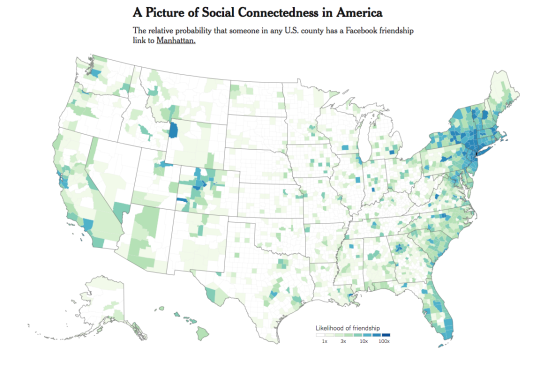
    Economists at Facebook, Harvard, Princeton and NYU recently analyzed anonymous Facebook data in order to study our social connectedness. The New York Times’ Upshot wrote about it here and it is a must read.

    There are a number of interesting takeaways from the study. One of them is that geography, distance, and political boundaries actually matter a great deal when it comes to our connectedness. 

    In other words, Americans are more like to be connected to someone nearby – within county or state boundaries – than they are to someone further away who may be infinitely more similar. This may seem somewhat intuitive.

    But at the same time, having a dispersed network also suggests certain things. Here’s the relationship that they discovered:

    These networks are important in part because of other patterns that are correlated with them. Counties with more dispersed networks — where a smaller share of Facebook friends are located nearby, or among the nearest 50 million people — are on average richer, more educated and have longer life expectancies. Places that are more closely connected to one another also have more migration, trade and patent citations between them.

    Counties that are more geographically isolated in the index are more likely to have lower labor force participation and economic mobility, and they have higher rates of teenage births. Some of the most economically distressed parts of the country appear to be the most disconnected: Among the 10 U.S. counties with the highest share of friends within 50 miles, six are in Kentucky.

    Again, it is worth checking out the full article. There’s also an interactive map to play around with.
  • Less is a bore

    image

    Architect Robert Venturi died this week at his home in Philadelphia. He was 93. Here is his obituary from the New York Times.

    Robert Venturi was, along with his partner and wife Denise Scott Brown, a central figure in 20th century American architecture. He is often referred to as one of if not the father of postmodernism. But apparently he wasn’t too keen on that moniker.

    Venturi is famous for writing both “Complexity and Contradiction in Architecture” and “Learning from Las Vegas”. But his firm also employed somewhere around 100 people at its peak.

    Venturi was critical of modernism for its hatred of ornament and for its purist belief that “less is more.” He argued that decoration had long been used in architecture to convey meaning, hence the response: “less is a bore.”

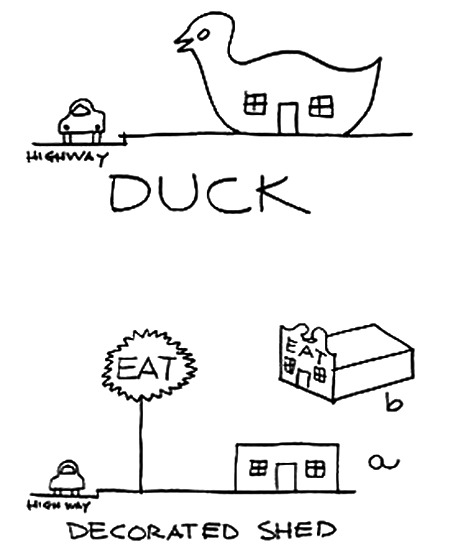
    Out of his work in Las Vegas came the notable comparison between a “duck” and the “decorated shed.” See above. The duck is modernism. The building itself becomes the symbol. No ornament is needed.

    The decorated shed, on the other hand, uses signage and other ornament to convey its symbolic qualities. The building itself can then be fairly nondescript, which also makes it flexible to a variety of different uses.

    This decorated shed approach is what guided the firm’s work and in 1991 he was awarded the Pritzker Prize in Architecture. 

    I love that he tried to have the award go equally to his partner Denise Scott Brown. The jury declined his request but he still used “we”, instead of “I”, throughout the entirety of his acceptance speech. Good.

    Thank you, Robert Venturi, for all of your contributions to architecture, as well as to the University of Pennsylvania.

  • Electric scooters in Los Angeles

    Bloomberg Businessweek just published this article summarizing the impact that Bird and its electric scooters are having on Los Angeles. Here are a couple of highlights:

    – Bird launched a year ago and is, today, valued at around $2 billion.

    – The company has around 15,000 scooters on the road in Los Angeles. We already know that this is making some/many people grouchy.

    – The cost to rent a scooter is $1 plus $0.15 a minute.

    – LA has an incentive program in place that allows Bird to expand its fleet within low-income areas. Still, their scooters tend to be concentrated in wealthier areas of the city.

    – Beverly Hills is trying to figure out how to handle/regulate these scooters and currently has a 6 month ban in place.

    – Supposedly, you can ride a Bird through West Hollywood but you’re not allowed to park it anywhere.

    The company is based in Santa Monica, so it’s not surprising that they have such a stronghold in the LA market. Still, there appears to be a lot of latent demand for this kind of mobility.

    image

    According the US Department of Energy, almost 60% of vehicle trips in the US last year were less than 6 miles. And around 40% were less than 2 miles. 

    So these “last mile scooters” do appear to have a lot of utility. Do any of you regularly use an electric scooter to get around?

  • The un-hotel

    According to Condé Nast, the coolest hotel trend for 2018 is the “un-hotel.” Here’s what they mean by that: “Instead of many rooms under one roof, these new un-hotels have different rooms in various locations, united only in character and concept.”

    I wrote about one of these un-hotels, the Vipp Shelter, back in the spring. I was interested both in how the company was using their hotel as a kind of shop and how they had adopted this decentralized approach to hospitality.

    Different rooms in different locations has got to create some diseconomies. But the appeal is clear. We are all craving new experiences.

    To me, it feels like a hybrid between an Airbnb and a boutique hotel. You get to “travel like a local”, but you’re still staying with a brand and there’s likely some sort of unifying concept across the portfolio.

    Check out the SWEETS hotel in Amsterdam.

    Image: SWEETS hotel

  • Leading female architects

    Reed Kroloff has a noteworthy piece in the New York Times talking about how architecture is no longer just a ‘gentleman’s profession’. Though less than a third of AIA (American Institute of Architects) members are females, “offices led or owned by women are creating an ever-wider range of public buildings that address architecture and urbanism in new and invigorating ways”, says Kroloff.

    I am thrilled, but not surprised, to see Jeanne Gang of Studio Gang on the list (pictured above). Her firm is the design architect behind our One Delisle proposal. And I was also happy to see Magui Peredo of Estudio Macias Peredo on the list. She is based in Guadalajara and, if you aren’t familiar with her work, I recommend you check it out. I love the materiality of it.

    Image: New York Times

  • Any decision over no decision

    The Hard Thing About Hard Things is a book that I read a number of years ago (Amazon just told me that I purchased it on March 12, 2014), but that I frequently come back to in my mind. 

    One of my favorite themes in the book can be summed up with this quote: “Often any decision, even the wrong decision, is better than no decision.”

    Decisions can be scary. What if I make the wrong decision and things go horribly wrong? Then things are on me.

    In some organizations, indecision may feel like the safest decision. Let’s do one more study just to make sure that we’ve got this right. 

    But in a startup (which is what Ben Horowitz’s book is about) and in organizations that would actually like to grow, innovate, and accomplish things, indecision can mean death. Without decisions, organizations lock up.

    None of this is to say that bad decisions are okay. Executives must make high quality decisions as fast as possible, and as a rule of thumb you probably want to make more good decisions than bad decisions. 

    But speed, momentum, and organizational clarity also matter a great deal. 

    One of the reasons why I mentally come back to this book is because oftentimes I find that things can get hung up on relatively inconsequential decisions. So I like to remind myself that go is better than stop.

    As Ben points out in his book: “The only mistake you cannot make is running out of cash.” And time has a funny way of burning through cash.

  • Housing supply and displacement in San Francisco

    Joe Cortright recently wrote about a study by Kate Pennington (UC Berkeley), which looked at the impact of housing production on legal eviction in San Francisco. The goal was to figure out if new housing supply actually causes displacement.

    To do this, Pennington went block-by-block and looked at new housing projects, as well as over a decades’ worth of eviction notices. 

    The relationship between the two was found to be “statistically indistinguishable from zero.” In other words, the “monthly probability of an eviction notice” does not change when new housing supply is completed nearby.

    Some have been critical of her findings and some have questioned whether legal eviction notices are, in fact, the right proxy for displacement.

    But I agree with Joe Cortright in that this still feels like a meaningful relationship to understand, especially when we’re talking about a tight housing market like San Francisco’s.

    Photo by Matthew Cabret on Unsplash

  • Uber to invest $200 million in Toronto

    Uber CEO Dara Khosrowshahi was in Toronto today, where he announced that the company plans to invest more than $200 million over the next five years to expand the autonomous vehicle research lab that it already has here in the city. 

    The Toronto outpost of Uber’s Advanced Technologies Group (ATG) – which is its only international outpost – is led by renowned University of Toronto professor, Raquel Urtasun. She is also the cofounder of the Vector Institute for Artificial Intelligence and splits her time between Uber and UofT.

    With this investment, Uber also expects to open its first engineering facility in Canada and grow its local headcount to 500, up from the 200 or so it has today. Some of these hires will be local. Some will be international. And some will be transplants from Uber’s other offices.

    Also notable about the announcement is that Khosrowshahi mentioned that he thinks fully autonomous vehicles roaming the streets of our cities is a good 10 years away. But I wonder if that isn’t political PR speak intended not to spook its drivers. So are we closer to the mid-2020′s?

    Either way, as a proud Torontonian and UofT alumnus, I was happy to see this announcement. I think it’s far more exciting than the Apple event that took place earlier this week.

  • Invisible walls

    image

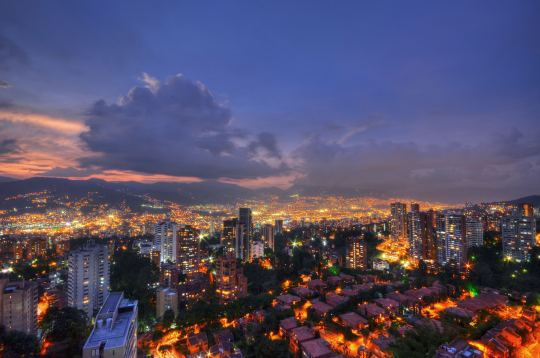
    This is an interesting working paper by a team of researchers at NYU’s Marron Institute of Urban Management. The paper examines the relationship between urban density and organized violence, first in Colombia and then within a sample of 200 global cities.

    The finding is that organized violence actually increases the population density of the surrounding areas within a city because it creates a kind of “invisible wall” – effectively a no-go zone.

    This makes perfect intuitive sense, but it’s not something I ever considered. Geography and other natural constraints typically drive density. Think about the island of Manhattan. But so too can invisible walls.

    For the full working paper, click here.

    Photo by Joel Duncan on Unsplash

  • Microsoft Canada moving to CIBC Square

    image

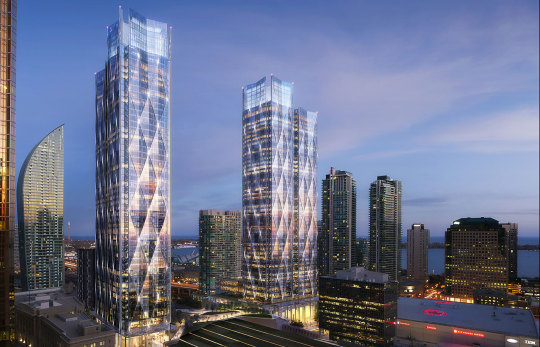
    Today, Microsoft announced that it will be moving its Canadian headquarters from Mississauga to the new CIBC Square development that is currently under construction in downtown Toronto (and rendered above). 

    According to RENX, Microsoft will occupy 132,000 square feet across 4 floors in the first tower. Occupancy is scheduled for September 2020.

    I love this project. The design architect is WilkinsonEyre. And there’s going to be an elevated one-acre park spanning the rail corridor between the project’s two towers.

    But it’s also noteworthy because it is an example of a major suburban tenant deciding to relocate to a transit-oriented urban environment. (I have a post on this somewhere.) 

    Image: WilkinsonEyre