Daily insights for city builders, delivered every morning at 6 AM ET. I’m Brandon Donnelly — a Toronto-based real estate developer and founder of Globizen. I’ve been writing here since 2013.

Month: January 2018

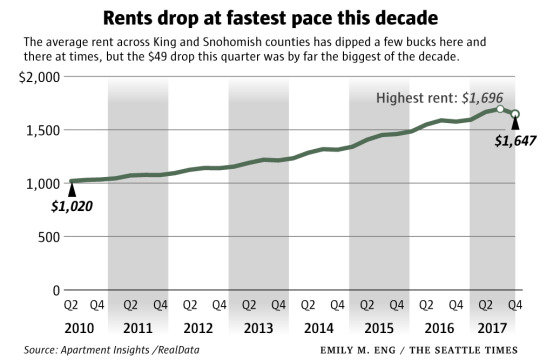
  • Why are apartment rents in Seattle dropping?

    This week I saw it reported that in this decade alone, the Seattle area is set to deliver more new rental apartments than it did in the prior 50 years combined. 

    And as a result, the sentiment is that new housing supply is finally starting to keep pace with demand and put downward pressure on rents. 

    Do you remember who was the crane capital of the US a year ago? They may still have that title.

    In some of the most desirable neighborhoods of Seattle – where much of the new supply is coming online – rents dropped 6% compared to the prior quarter. At the county level, this last quarter was by far the biggest drop of the decade according to the Seattle Times.

    Funny how that works.

    It’s also worth noting that the US as a whole is building far more rental apartments than condominiums. Here is a post I wrote in August 2015 which pegged condos as a percentage of overall multifamily construction at around 5.5%. That’s a tiny percentage.

  • Class action litigation filed against GoPro

    Snowboarding season is starting late for me this year. But that doesn’t mean it will be any less epic. So far this season Jackson Hole has had 221″ of snow.

    This year I’m introducing a GoPro gimbal stabilizer into the mix. Here is a good example video of the difference a stabilizer makes – buttery smooth video footage. I am a big nerd when it comes to gear and tech, and I guess many other things as well.

    But judging by GoPro’s stock right now and the cliff it fell off of at the beginning of this month, I may be in the minority when it comes to worrying about buttery smooth snowboarding videos.

    Sales over the holiday season were disappointing and they recently announced that they’re discontinuing the Karma drone. GoPro is now said to be shopping for a buyer.

    Part of the problem may be their narrow action sports use case. When I’m on a mountain, I love my GoPro gear. But when I’m not snowboarding, I struggle to find consistent value in it. We all just use our phones to capture photo and video.

    To make matters worse, class action litigation was recently filed against GoPro, and the company’s CEO and CFO. Investors are claiming that they failed to disclose, among other things, that demand for the GoPro brand had declined dramatically.

    Who do you think would be a good buyer for GoPro?

  • My even shorter Amazon HQ2 shortlist

    Amazon released its shortlist of HQ2 cities this morning. Below are the 20 metropolitan areas. They were selected from 238 bids, so this shortlist represents 8.4% of the original pool.

    • Atlanta, GA
    • Austin, TX
    • Boston, MA
    • Chicago, IL
    • Columbus, OH
    • Dallas, TX
    • Denver, CO
    • Indianapolis, IN
    • Los Angeles, CA
    • Miami, FL
    • Montgomery County, MD
    • Nashville, TN
    • Newark, NJ
    • New York City, NY
    • Northern Virginia, VA
    • Philadelphia, PA
    • Pittsburgh, PA
    • Raleigh, NC
    • Toronto, ON
    • Washington D.C.

    I saw some people on Twitter say that they were surprised to see Toronto and Miami on this list. I was not. If you remember, I publicly predicted on this blog that Toronto would be selected for Amazon HQ2.

    That said, I thought it would be fun to guess at an even shorter list from Amazon’s shortlist. I have no knowledge of Amazon’s actual selections process, but if I had to guess, here is who I would cross off the list:

    • Atlanta, GA
    • Austin, TX
    • Boston, MA
    • Chicago, IL
    • Columbus, OH
    • Dallas, TX
    • Denver, CO
    • Indianapolis, IN
    • Los Angeles, CA
    • Miami, FL
    • Montgomery County, MD
    • Nashville, TN
    • Newark, NJ
    • New York City, NY
    • Northern Virginia, VA
    • Philadelphia, PA
    • Pittsburgh, PA
    • Raleigh, NC
    • Toronto, ON
    • Washington D.C.

    That leaves us with a list that looks like this:

    1. Boston, MA
    2. Miami, FL
    3. Montgomery County, MD
    4. Newark, NJ
    5. Northern Virginia, VA
    6. Toronto, ON
    7. Washington D.C.

    So why this list? I’m probably wrong, but my reasons are as follows:

    – I think Amazon will opt for a metro area on eastern time.

    – There seems to be a predilection for areas around Washington D.C., so I left Montgomery County and Northern Virginia. 

    – As wonderful as it is, New York City feels too center ice for Amazon – at least in my view. But maybe Newark places them in the catchment area.

    – The area needs to be of a certain scale so Amazon doesn’t overpower it and they have enough human capital to draw from.

    – Miami is my sleeper bet. Most people think of it simply as a resort town, but there’s a huge percentage of foreign born residents and powerful arts/design scene.

    – Talent is number one, which is why I left Boston and Toronto and why I continue to believe in Toronto. Toronto is more dynamic than Boston.

    If I had to pick just three from the above shortlist, my bets would be, in alphabetical order: Boston, Toronto, and Washington D.C. What are yours?

  • It doesn’t matter what Bitcoin is trading at right now

    Steven Johnson has a terrific piece in New York Times Magazine called: Beyond the Bitcoin Bubble. Here is a snippet:

    The only blockchain project that has crossed over into mainstream recognition so far is Bitcoin, which is in the middle of a speculative bubble that makes the 1990s internet I.P.O. frenzy look like a neighborhood garage sale. 

    But the point of the article, as its title suggests, is to talk about what all of this craziness could mean for the future of the internet and how, in some ways, it could be a return to what the internet was always intended to be.

    The real promise of these new technologies, many of their evangelists believe, lies not in displacing our currencies but in replacing much of what we now think of as the internet, while at the same time returning the online world to a more decentralized and egalitarian system. If you believe the evangelists, the blockchain is the future. But it is also a way of getting back to the internet’s roots.

    Some are calling this new, decentralized internet version 3.0. We are currently living with internet 2.0. Practically speaking though, what could this shift really mean for us?

    One example that is given in the article has to do with urban mobility – a topic that is particularly relevant to this audience. 

    Internet 2.0 has created a winner-take-most economic model. And in the case of mobility – at least in the world of apps – that winner is Uber. But with internet 3.0 and the blockchain, this could be possible:

    Just as GPS gave us a way of discovering and sharing our location, this new protocol would define a simple request: I am here and would like to go there. A distributed ledger might record all its users’ past trips, credit cards, favorite locations — all the metadata that services like Uber or Amazon use to encourage lock-in. Call it, for the sake of argument, the Transit protocol. The standards for sending a Transit request out onto the internet would be entirely open; anyone who wanted to build an app to respond to that request would be free to do so.

    Cities could build Transit apps that allowed taxi drivers to field requests. But so could bike-share collectives, or rickshaw drivers.

    I don’t know about you, but I find this perspective a lot more interesting. I recommend you read Steven’s article. It will help you cut through a lot of the Bitcoin noise.

  • How to act like an entrepreneur

    I really like the post that Seth Godin wrote on his blog today called: The four elements of entrepreneurship.

    He defines entrepreneurs through their actions and behaviors. In his view, this is what they do:

    1. They make decisions.

    2. They invest in activities and assets that aren’t a sure thing.

    3. They persuade others to support a mission with a non-guaranteed outcome.

    4. This one is the most amorphous, the most difficult to pin down and thus the juiciest: They embrace (instead of run from) the work of doing things that might not work.

    As far as I can tell, that’s it. Everything else you can hire.

    He then goes on to say:

    All four of these elements are unnatural to most folks. Particularly if you were good at school, you’re not good at this. No right answers, no multiple choice, no findable bounds.

    Perhaps this is why many VCs seem to favor young founders. They’re not old enough to think they know what will work and what will not work.

  • “Liberate these objects from their containment”

    Architect Rem Koolhaas recently unveiled a backpack that he designed for Prada’s autumn winter 2018 menswear collection

    It looks like this: 

    image

    It’s more of a frontpack. Actually, maybe the right name is chestpack.

    What stood out for me, though – perhaps more than its frontality – was the way that Rem Koolhaas described his reasoning behind the design.

    Here is an excerpt from Dezeen:

    “Today, waiting in line for a typical airport check of carry-on luggage, it is surprising to note how the shapeless container of the backpack, is inhabited by strict, orthogonal devices like the laptop, the charger, books, toilet bag, and how awkward it is to liberate these objects from their containment in the backpack,” he said.

    “This project proposes a reinterpretation of the backpack, more suitable to the contemporary urban citizen,” he continued. “The frontal position gives a more intimate sense of ownership – a better control of movement, avoiding the chain of oblivious collisions that the backpack inadvertently generates.”

    Leave it to an architect to talk about a backpack like the wearer is about to go to war.

    P.S. I’m a fan of Koolhaas. I just found this funny.

    Image: Prada

  • Where the young and educated are moving to in the US

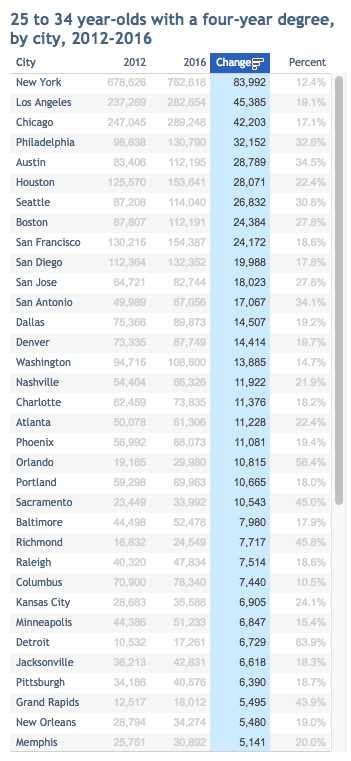
    City Observatory tracks something that they call “The Young and Restless.” It refers to the segment of the US population that is between 25-34 years old and has a bachelor’s degree or higher.

    We know that people in this age bracket tend to be relatively mobile and that the likelihood of moving decreases as people age. So it’s a potential leading indicator for the city regions of the future. It also adds a bit more nuance to the urban vs. suburban growth debate. 

    According to City Observatory, between 2012 and 2016 the number of 25 to 34 year olds with a 4-year degree living in one of the 53 largest largest cities in the US increased by 19%. This is compared to a 4% increase in the overall population in these cities.

    This increase in young well-educated adults is also happening 50% faster in the largest cities. So the young and educated still seem to be demanding city living, even if the world is arguably still suburbanizing.

    Below is a snapshot of City Observatory’s latest data. I’ve sorted the list by total change in population (2012 to 2016). Happy to see Philadelphia near the top. If you do it based on percentage, Detroit wins with a 64% increase.

    For the full list of cities, check out City Observatory.

  • Hong Kong in plan view

    This morning I came across this drone photo of Hong Kong by @vnthota:

    image

    I immediately thought it was a good example of the typical Hong Kong tower plan that I have been writing about on this blog. You can see the cruciform plan, the light/air cutouts, and how this plan allows for towers to be built directly beside each other.

    In some cases the result is perhaps not that dissimilar from a European courtyard block, except the building typology here is high-rise as opposed to mid-rise. Note the outdoor spaces in the middle of the blocks.

    The cruciform plan also creates a secondary scale of courtyards at the corners of these “tower courtyard blocks.” That is, where you have 3 towers arranged in a triangle. I only see two instances where you have 4 directly adjacent towers. Probably discouraged.

    It’s also interesting to note how relatively subtle shifts in tower positioning seem to open up the possibility of additional towers. You can see that just below the boat in this picture (not sure what the boat is all about).

    Is there anything else you find interesting in this picture?

  • How the Time Warner Center came to be

    New York Magazine is running a weekly series right now that tells the stories behind key moments in the city’s cultural history. This week’s is about how the Time Warner Center came to be.

    Like most real estate projects, it took an enormous amount of time for it be realized. Multiple developers had attempted to buy the site, which previously housed the New York Coliseum.

    In 1987, the agency put out a call for proposals, its parameters calculated to yield the highest price and the biggest building. Among the 13 developers who responded was Donald Trump, who proposed the world’s tallest tower, 137 stories high.

    It’s a good example of just how difficult it can be to get a large project off the ground. The Time Warner Center opened in 2003. Thank you Paul for sending this along. Click here for the full story. 

  • Paris syndrome (in China)

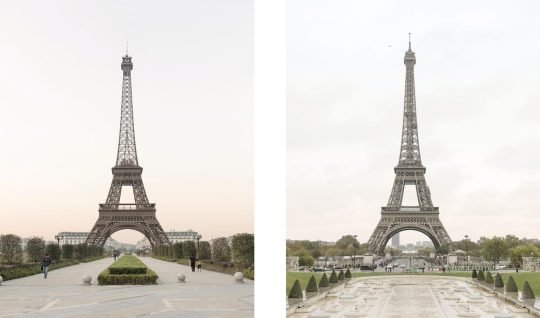
    French photographer and graphic designer François Prost has a new photo series out that I thought I would share with you today. It’s called “Paris Syndrome” and I discovered it via CityLab.

    What the series does is visually compare Paris to a housing estate in Hangzhou, China called Tianducheng, which was designed to be a replica of Paris. Tianducheng even has its own Eiffel Tower, though this Chinese version is only 108m tall and the French original is 324m.  

    image

    Still, in many of François’ photos, you may find it difficult to distinguish between the two (provided you ignore the Chinese people and the Chinese signs). The neighborhood was initially a ghost town, but apparently it’s now starting to fill up.

    The reason I mention this photo series is because it reminded me of the day that I spent in Macau last week. I’m not much for gambling – and Macau is firmly the gambling capital of the world with revenues that greatly exceed Las Vegas – but I was curious to see it.

    Similar to Hong Kong, Macau is a Chinese Special Administrative Region with a lot of autonomy. But from 1557 to 1999 it was under Portuguese administration. And so historically it has been home to this very unique Eurasian culture spanning everything from food to language. 

    I say “historically” because the Macanese and their Patuá language – which is supposedly a blend of Portuguese, Cantonese and Malay – seem to be on the brink of extinction

    Today it’s all about the casinos. And the demand is firmly coming from mainland China. In 2016, 90% of Macau’s 31 million tourists came from there.

    I fully appreciate the demand drivers, but I struggle to understand the allure of replicating and bastardizing attractions from other places. Macau also has an Eiffel Tower, as well as a Venetian (like Las Vegas). You can go for gondola rides in its canals.

    The more interesting part for me was the historic center of Macau with its Portuguese paving on the sidewalks. But maybe that’s just me.

    Image: François Prost