Daily insights for city builders, delivered every morning at 6 AM ET. I’m Brandon Donnelly — a Toronto-based real estate developer and founder of Globizen. I’ve been writing here since 2013.

Month: August 2017

  • Frontier city

    Opposition to new development is nothing new in this city. In fact, it’s the norm in almost all cities, regardless of how big or small the project might be.

    But the battle happening right now in Toronto with respect to the proposed 8 storey condominium project at 321 Davenport Road is certainly taking things to the next level. All over 16 units.

    Some of the most recognized names in this city have their hat in the ring and virtually every media outlet has covered the topic. See here, here, here, and here, for a small taste.

    Just this evening I saw that Shawn Micallef (yes camp) had sent a copy of his recent book to Margaret Atwood (no camp) in the hopes that she would read it and better appreciate why it behooves our neighborhoods to move past this “village mentality.”

    If you haven’t yet read it, it’s called Frontier City: Toronto on the Verge of Greatness. I’ve just moved it to the top of my reading pile. I hope more folks do the same.

  • Is sprawl to blame (at least partially) for the flooding in Houston?

    What’s happening in Houston right now is devastating. Ian Bogost of The Atlantic is calling the flood a “disaster of biblical proportions.” Harvey has unloaded 9 trillion gallons of water.

    It is once again reminding us of the importance of resiliency when it comes to our cities.

    One emerging argument is that this is an almost inevitable outcome for Houston, brought on by the multiplicative effects of climate change, unfettered urban sprawl, and poor design decisions.

    The barriers to development are famously low in Houston, which allows the city to quickly add housing and people. There are many benefits to this. 

    But it also means that there has been, among other things, a dramatic increase in the amount of impervious surface.

    This matters because impervious surface creates runoff.

    According to The Texas Tribune, impervious surface in Harris County (third most populous county in the U.S.) increased by 25% between 1996 and 2011. 

    And it replaced things like the below prairie grass (switchgrass), which are highly absorbent as a result of their deep root system. 

    But much like climate change, not everyone believes this is to be blamed. 

    For more on this, check out The Texas Tribune’s full interactive piece. It’s called “Boomtown, Flood Town” and it’s worth a read.

    Image from The Texas Tribune

  • 4 years

    Today is the 4 year anniversary of this daily blog.

    Sure, I’ve missed a few days over the years (my estimate is 4-5 days), but for the most part I have shown up here every day and written something. 

    Sometimes that something is very short and/or bad. I’ve had a few people say to me: “I can tell when you’re super busy. Your posts are shorter.” I’m okay with that. Part of this exercise for me is simply about the discipline. 80% of success is showing up, right?

    In some ways, what I do here is an anachronism. Here is a good vintage article (2011) that talks about two different schools of thought when it comes to blogging.

    The reality is that it’s painfully slow and difficult to build an online audience via a personal blog using your own domain. It takes years, unless you’re a celebrity, which I am most certainly not. That’s why many people give up.

    Instead, many people/influencers choose to build their audience on top of an existing network, such as YouTube, Instagram, or Medium. Medium is pretty tempting and I’ve seen lots of bloggers port over their personal blogs.

    The idea here is that you simply bring your content to where your/an audience already lives, instead of trying to get them to come to you. 

    Of course, one of the risks of this approach is that you don’t own/control the platform. What if people one day decided to stop using MySpace? I like the idea of owning (at least part of) my online presence.

    So here’s to another year on the blog. Thanks for reading! I really do appreciate it. Regular scheduled programming will resume tomorrow.

  • Network effects for autonomous vehicles

    In my recent post about why I write about tech on this city building blog, I made a pithy comment about autonomous vehicles and why it is “largely a software challenge.” 

    The argument I was trying to make was that the hardware, similar to smartphones today, will likely become a commodity. More of the value will end up flowing to the firms that control the software.

    Benedict Evans has an excellent deep dive into this topic on his blog. The post is called: Winner-takes all effects in autonomous cars.

    Here’s an excerpt about hardware:

    To begin with, it seems pretty clear that the hardware and sensors for autonomy – and, probably, for electric – will be commodities. There is plenty of science and engineering in these (and a lot more work to do), just as there is in, say, LCD screens, but there is no reason why you have to use one rather than another just because everyone else is. There are strong manufacturing scale effects, but no network effect. [My link, not his.]

    And here’s his conclusion:

    So, the network effects – the winner-takes-all effects – are in data: in driving data and in maps.

    That said, it is still early days for autonomous vehicles. Who knows if these network effects will end up being highly defensible or weak. There are still lots of assumptions and questions at this stage.

    From a city building perspective, one of the major concerns with autonomous vehicles is that they could tempt us back to car-centric city planning. That would be a shame.

    Photo by Zachary Staines on Unsplash

  • Official bilingualism

    When I was around 8 or 9 years old my mother put me into a French school in Toronto. Her logic was simple: “This is Canada. You should know how to speak both official languages. It will create opportunities for you in the future.”

    But I hated it. I couldn’t speak a word of French at the time and so I would come home from school complaining that I couldn’t understand anything the teacher was saying. How was I supposed to learn anything? 

    I begged her to put me back into an English school.

    To her credit, my mother remained absolutely steadfast. She would say to me: “Trust me. You’re going to thank me for this later.”

    Not surprisingly, I learned French. I was put into a special “intro” stream and so when my classmates were off learning a third language (German), I was given introductory classes designed to bring me up to their French level.

    I still remember the sense of accomplishment I felt when I could finally carry on an actual conversation in French.

    Sadly, at this point in my life, my French is fairly rusty. I really should work on that. But it’s decent enough that people in Montréal – which is where I am right now – will say to me: “You’re from Toronto. How is it that you speak French?” 

    In fact, somebody said to me last night that in Montréal they typically encounter more French speakers from the U.S. than they do from Ontario. That surprised me. As a country, about 10 million Canadians report being able to speak French (2011 number).

    Every time I visit Montréal, I marvel at the display of bilingualism that seems omnipresent in this city. And, if you grew up in an immigrant household, you may also speak a third language – the one your parents spoke to you in. I think that’s wonderful.

    So with that: thanks mom.

  • Why I write about tech on my city building blog

    I had a friend ask me this week about how I decide what to write on this blog. His comment was that I tend to write about a variety of different topics. He wondered: Isn’t it better to focus on one particular niche?

    The simple answer is that I write about what interests me. And secondary to that is any concern around what will get the most clicks. In fact, I try not to fall into the trap of worrying about the latter. Sometimes it can be paralyzing to fixate on what will appeal most to the tens of thousands of people who read this blog on a regular basis.

    The reality is that my interests are much broader than, say, just design and real estate; though these two topics are clearly central. 

    I learned a long time ago while studying architecture and art history that what we make as a society is generally a product of the cultural milieu at the time. In other words, the built environment doesn’t happen in a vacuum. It is the physical manifestation of what we believe to be true at a particular moment.

    Today, it’s pretty hard to ignore the importance of tech. Think of some of the most valuable companies in the world right now: Apple, Google, Amazon, Facebook, and so on. Now, technology has always shaped our cities, but what makes this moment different is the decisive shift toward software.

    It’s arguably no longer about who can build the best mousetrap. It’s about who can build the best software layer on top of that mousetrap.

    In 2011, venture capitalist Marc Andreessen (previously the co-founder of Netscape) published a widely shared essay called, “Why Software Is Eating the World.” And over the past 6 years he has been proven to be very right.

    The 3 main points he aimed to make with that essay are as follows:

    1. Every product or service that can become software will become software.
    2. Every company will have to become a software company.
    3. The winning companies will be the best software companies.

    Depending on your industry, this may sound ludicrous to you. Certainly in 2011 it probably seemed that way. 

    But a perfect example of this phenomenon is the iPhone. The phone itself is manufactured in China, albeit where a lot of great hardware innovation is taking place. 

    But at this point, phones have become fairly commoditized. The profits that Apple makes from the iPhone disproportionately come from the software layer and the app ecosystem it has developed.

    You could make a similar argument with Tesla. Autonomous navigation – which most of us can agree will have a profound impact on cities – is largely a software challenge. 

    And so if you believe that autonomous vehicles will be a fundamental part of the future of mobility, then it’s not that hard to believe in point number three: the winning car company will also have to be the best car software company.

    Some industries have been less touched by tech and software – real estate being one of them. But if Andreessen is right and it’s not a question of if, but a question of when, then it behooves all of us to think about the potential impacts.

    I love how Andreessen ends this podcast discussion with Barry Ritholtz of Bloomberg and so I’m going to repeat it here to close out this post. He says: “There are no bad ideas. There are only early ideas.” 

    And that’s why I write about tech on my city building blog.

    Photo by Michal Pechardo on Unsplash

  • The year of the condo

    Over the past 5 years or so, real estate headlines in the Greater Toronto Area have often focused on the rapid appreciation of low-rise housing. High-rise housing simply wasn’t appreciating at the same rate – at least in aggregate terms.

    But 2017 has brought a different story. 

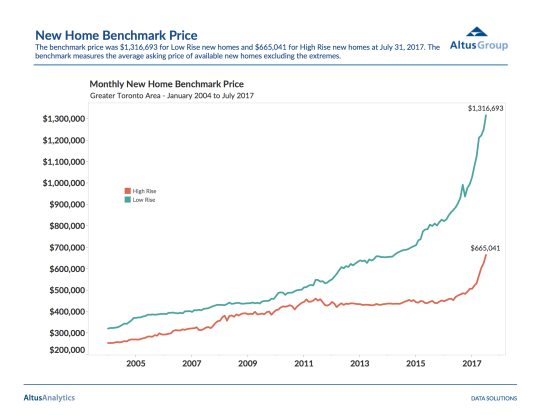
    If you look at BILD’s “New Homes Monthly Market Report” (data provided by Altus Group as of July 2017), you can see that high-rise pricing is now on a similar trajectory to low-rise pricing.

    Here is that graph:

    image

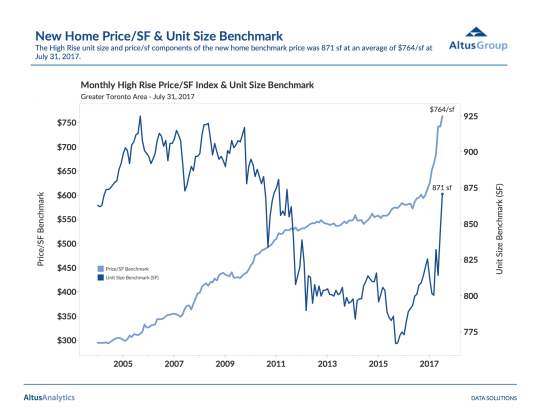
    This sharp uptick in pricing is also apparent when you look at the average price per square foot of new high-rise inventory. As of July, it was $764 psf across the GTA. See below.

    At the same time, average unit sizes have also jumped up to 871 square feet. So not only are new high-rise homes becoming more expensive on a normalized basis, they are also getting bigger, which further increases prices.

    image

    I recognize that we’re only seeing data up to the end of July, but, from the looks of it, 2017 is shaping up to be an extraordinary year for the condo.

    Of course, part of the reason this is happening is because remaining inventory for both low-rise and high-rise product is hitting 10-year lows. We’re back to the topic of supply.

    If you’re curious how some of these numbers have changed from the month prior (June 2017), check out this post.

  • $2-billion real estate king

    The Globe and Mail just published a piece called: How Morguard CEO Rai Sahi became Canada’s $2-billion real estate king. It’s a Globe Unlimited piece, so some of you may not be able to access the article. 

    But here’s a snippet that talks about the moment Sahi left his job at the Bank of Montreal and went out onto his own as an entrepreneur:

    In 1981, Sahi spotted an opportunity: Advanced Extrusions Ltd., a small manufacturer of aerosol cans and toothpaste tubes based in Penetanguishene, Ontario. Along with several partners, he bought the business for $7 million. Quickly, Sahi and his partners kicked Advanced into high gear by installing a high-speed assembly line and taking advantage of the low Canadian dollar to boost exports to the United States. Revenues doubled, and CCL Industries Inc. bought the company in 1985 for a reported $22 million. He then used the proceeds from the Advanced sale as a launchpad to buy control of two transport companies, combined them, and sold them to Winnipeg-based Federal Industries for $70 million, much of it in shares.

    The reason for this Globe article is no doubt because Sahi’s Glen Abbey golf course is in the news right now. He acquired the course by buying ClubLink when they were in a cash crunch and has since put forward plans to redevelop the land. 

    On Monday night, Oakville city council voted unanimously to seek a heritage designation for the course.

    I don’t know much about golf courses, but I do think Sahi’s story is an inspiring one. Here is a guy who moved to Canada at the age of 24 and started out by selling insurance door to door. And today his net worth is estimated at $2 billion.

    Full disclosure: I used to work at Morguard.

    Photo by juan gomez on Unsplash

  • Crowd Surf

    When Snap Inc. announced its Q2 financial results earlier this month, it reported 173 million daily active users – an increase of 21% year-over-year. But this fell short of what was expected. Analysts were expecting 175.2 million DAUs

    (Snap defines a DAU as anyone who opens the Snapchat app during a defined 24 hour period.)

    Regardless of your position on this stock, one thing is clear about the company: they are very creative and they continue to innovate.

    The company is currently testing a new feature called “Crowd Surf.” What it does is automatically stitch together related Snapchat Stories from the same location to form seamless videos. 

    It made its debut at a concert in San Francisco. The real magic is how Crowd Surf was able to assemble a continuous audio track using an assortment of 10-second Snapchat Stories, all taken from different locations at the concert and all from different users.

    Click here and scroll down for a preview video.

    To accomplish all of this, Snap takes a “sound print” of the audio playing in a particular location from people’s Stories. It then filters each of the clips so they sound more alike and autogenerates a stitched together video.

    You obviously need a critical mass of users and content for this to work, which is why the feature was introduced at a concert. But it’s certainly a remarkable way of creating valuable content from decentralized user inputs.

    I guess the only question is: How long until Instagram copies this?

    Photo by Yvette de Wit on Unsplash

  • Supply, not foreigners

    The chief economist at the Canada Mortgage and Housing Corporation (CMHC), Bob Dugan, recently published a piece in Macleans called: why the foreign buyers tax isn’t making Vancouver more affordable.

    Here’s an excerpt:

    One year after the implementation of the foreign buyers tax, monthly sales to foreign investors now hover around 4 per cent of all sales. But our latest Housing Market Assessment, released in July, still shows a red flag for Vancouver—with particular concern given to overvaluation and price acceleration. Average prices in Vancouver have rebounded to where they were before the tax’s implementation. In between, there was a marked drop, but it appears to have been temporary. In short, Vancouver is largely right back to where it was before the tax.

    He goes on to argue that while there are many factors affecting home prices, “supply is by far the chief factor.” This, of course, is a refrain you hear from everyone in the real estate business, so I’m not going to belabor the point.

    But I would like to point out some of the percentages. 

    Before the tax, foreign sales in Vancouver (to buyers who do not have a permanent address in Canada) were thought to sit at roughly 10%. Immediately following the tax, when everyone was trying to assess the impact, this dropped to ~0.9%. And now it’s back up to somewhere around 4%, according to the article.

    Arguably, there has been a slight reduction. Though who knows how accurate these percentages are. There is now a strong incentive to hide foreignness. 

    Regardless, CMHC doesn’t believe it’s working.