Daily insights for city builders, delivered every morning at 6 AM ET. I’m Brandon Donnelly — a Toronto-based real estate developer and founder of Globizen. I’ve been writing here since 2013.

Month: October 2016

  • 3 word addresses

    image

    When I was in undergrad, I spent a summer in Taipei. One of the things I remember about that summer was how difficult it was to locate building addresses. Sure, there was the whole language barrier thing, but I swear that some of those alleys (which I loved) didn’t follow a consistent numerical logic.

    It turns out that a lot of the world is actually poorly addressed. Think about the favelas in Brazil. How are they addressed? (Not actually a rhetorical question; I’ve never been.)

    A company out of the UK called what3words is trying to solve this problem. What they have done is created a 3m x 3m grid of the entire world and assigned a 3 word address to each square. Apparently that translates into about 57 trillion squares.

    This is similar to long / lat coordinates, except that 3 words are far more user friendly than a string of numbers. They are more easily remembered and more easily communicated to other people. The front door of the Starbucks in my neighborhood looks to be migrate.stunner.racing.
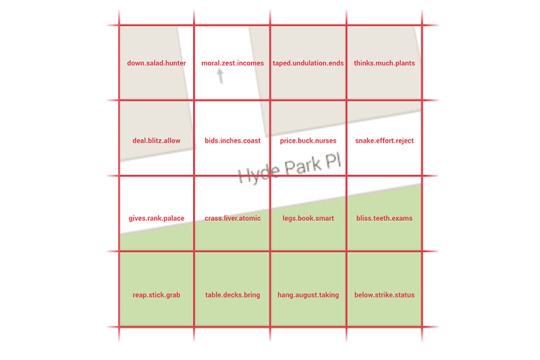
    One service that has built upon the what3words platform is a bike taxi service in Delhi that offers female drivers for female customers. It’s called Bikxie Pink and the 3 word addresses aim to solve the safety problem of inefficient pick-ups and drop-offs.

    Even in places where addressing isn’t generally a problem, I could see what3words helping. Interesting platform.

    Images: what3words
  • Some thoughts on how we plan cities

    I came across this discussion on Twitter yesterday about how so many of the spaces we love in cities would not conform to today’s modern city planning practices:

    //platform.twitter.com/widgets.js

    This is a topic I’ve been thinking about lately and so it’s a timely discussion. In fact, I’ll often come across spaces in Toronto where I’ll think to myself: This is a really great space. But it’s highly unlikely that it could be built this way today. Naturally the question then becomes: What does this say about modern city planning?

    City planning is obviously important. But at the same time, we are almost certainly making mistakes and doing things that we will later regret. I say this not because I’m particularly critical of planning today, but because cities are enormously complex entities and it’s difficult to believe that we’ve figured everything out at this point.

    One thing I wonder about is if we aren’t over-planning and being too prescriptive about our cities. Some of you will probably argue the exact opposite. But hear me out.

    Vancouver is a city that has long been considered to be the gold standard in modern city planning. We talk about its podium + tower building typology. We talk about its “gentle density.” And we talk about its great public and recreational spaces, among many other things.

    But when I was there last month having dinner with a friend of mine, she said something to me that stood out. She said: “Brandon, Vancouver is a boring city. If it weren’t for my family being here, I would happily move to Toronto, New York, or somewhere else.”

    Cities are amazing places because they unleash human ingenuity. They allow new and unforeseen things to emerge. The challenge, I think, is to not sterilize that away when we plan and build. And all of us involved in the building of cities are probably guilty of doing that to an extent.

  • Where Canada’s immigrants have come from

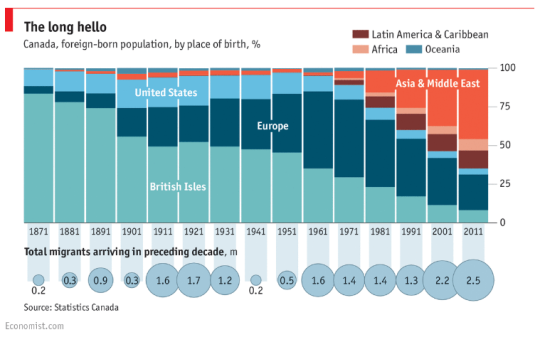
    Earlier today The Economist published the below chart showing where Canada’s immigrants have come from (place of birth) between 1871 and 2011. So basically from Confederation (1867) to today – almost.

    It’s a great chart. It really shows our evolution.

    Perhaps the most meaningful date to point out is 1962. That is the year Canada introduced new immigration regulations which effectively privileged skill and talent over race and national origin when it came to deciding who would be allowed to enter the country. 

    Look at the impact that had.

  • It’s content marketing

    Oscar Wilde once said:

    “There is only one thing in life worse than being talked about, and that is not being talked about.”

    I’m sure that all of you can think of someone right now who subscribes to the philosophy that any press is good press.

    But there is something to be said about exposure. Almost every company on the planet wants it. They pay for it.

    They fight for it.

    It’s the lifeblood of business. If nobody knows who you are and what you do, you’re dead.

    In my view, one of the best ways to gain exposure today is content marketing. Marketing sometimes has negative connotations, but content marketing is probably the least offensive varietal. It’s a soft, rather than hard, approach. It invites you in and tries to earn your trust, instead of hitting you over the head with an ask.

    But at the same time, it’s a more difficult form of marketing. You have to be insightful. You have to be useful. And you have to try and create value for people on a regular basis. That’s easier said than done. I try and do that every day, but I don’t always succeed.

    I say all this because we live in a content-driven world. In fact, this blog – despite it being a personal one – is a form of content marketing. I like how Fred Wilson responded on his blog to the criticism that too many entrepreneurs treat venture capital blogs as scripture:

    “So how should entrepreneurs use this knowledge that is being imparted by VCs on a regular basis? Well first and foremost, you should see it as content marketing. That is what it is. That doesn’t mean it isn’t useful or insightful. It may well be. But you should understand the business model supporting all of this free content. It is being generated to get you to come visit that VC and offer them to participate in your Seed or Series A round. That blog post that Joe claimed is not scripture in his tweet is actually an advertisement. Kind of the opposite of scripture, right?”

    Again, that doesn’t make the content necessarily bad. It’s just the truth. It’s content marketing.

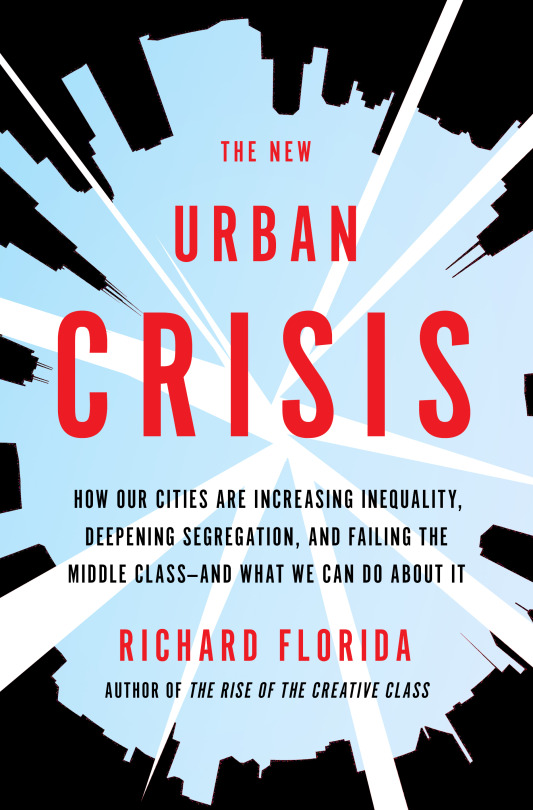
  • The New Urban Crisis

    Richard Florida has a new book coming out in the spring called, The New Urban Crisis

    Noteworthy about the book is that he has changed his tune with respect to the potential of the “creative class” to form the new middle class. Here’s a quote from the Houston Chronicle:

    “I got wrong that the creative class could magically restore our cities, become a new middle class like my father’s, and we were going to live happily forever after,” he said. “I could not have anticipated among all this urban growth and revival that there was a dark side to the urban creative revolution, a very deep dark side.”  -Richard Florida

    Regardless of what you think of the work of Richard Florida, I’m sure this book will be bedside for most urbanists. The focus is on creating a new kind of inclusive urbanism, which is top of mind for so many of us today.

    If you’d like to pre-order it, you can do that here.

  • Where do you shop?

    Matthew Townsend of Bloomberg recently published an interesting article talking about the dominance of Amazon.com (and online shopping in general); the shift towards experiences over stuff; and the languishing brick-and-mortar brands that keep saying it’s the macroeconomy, rather their product/approach, which is causing sales to slump.

    Here are a 3 excerpts that stood out for me:

    Lurking behind the cliché is a hard truth these executives are eager to avoid. “All this pleading that the consumer isn’t spending is an excuse, largely from management teams whose product is less relevant,” Kernan said. “The consumer is actually driving the U.S. economy, so it’s a little ridiculous when we hear the excuse of the macro environment is not good.”

    Another hurdle that isn’t going away is the shift to increased spending on experiences such as travel and classes, which make for much better posts on Instagram, Facebook, and Snapchat. “Social media has really fostered a have-done environment, which is not what retailers sell,” Perkins said.

    One characteristic of these struggling brick-and-mortar chains has been direct competition with Amazon. If they don’t go head-to-head with the online giant, they rely heavily on people visiting shopping centers anchored by retailers that do, such as ailing department-store chains Macy’s and Sears. One measure of store visits in the U.S. paints a dire picture, with only a dozen positive weeks over the past two years.

    According to Bloomberg, 55% of online product searches start at Amazon.com. And while online sales in 2016 have only accounted for 11% of all (U.S.) retail revenue, it has represented 54% of all growth! That’s a big number, especially when you think about what that will mean over time.

    Talking about the growth and threat of online shopping has become a boring truism. I know that. But are retail executives taking it seriously? The Bloomberg article gives you the sense that many are not – or at least they’re not publicly acknowledging it.

    When I look around my place right now and think about where I bought each item – everything from the shoes at my door to the protein powder in my cupboard – it’s pretty amazing to think about how much I now buy online. And I’m sure that many of you are the same.

    Groceries aside, I’m probably 85-90% online. What about you?

  • Airbnb’s 5 point plan

    New York State Governor Andrew Cuomo recently signed a bill that will levy heavy fines (up to $7,500) on Airbnb hosts who do not abide by local housing regulations.

    Hours after, Airbnb filed a federal lawsuit claiming “irreparable harm.”

    However, they also proposed a 5 point plan that they hope will make home-sharing work in New York City and then serve as a framework for new legislation.

    Here are Airbnb’s 5 points (summarized by me):

    1. One host, one home: Just like it sounds, this would limit people to renting a single home within the five boroughs.
    2. Require registration: State would require short-term rental hosts to register. Airbnb would be authorized to register people on behalf of the state.
    3. Make home-sharing work for all: Landlords would be able to set specific rules for short-term rentals in their buildings and then secure a portion of the revenue for maintenance and so on. (I would imagine that the same could be done by condo corporations.)
    4. Good neighbor rules: Platforms would be required to have dedicated 24/7 hotlines should any neighbor complaints arise as a result of home-sharing.
    5. Taxes to support affordable housing: Airbnb would collect and remit additional taxes on behalf of hosts, which could then be used for things such as affordable housing.

    It’s interesting to think about Airbnb’s evolution. It started out as air mattress rentals on the floor and nobody thought it would ever work as a business. Now it’s a huge business and governments everywhere are trying to figure out an appropriate response. Hopefully a suitable middle ground will be found.

    How do you feel about Airbnb’s proposed 5 point plan? With this framework, would you be comfortable with Airbnb in your building? I know that many of you are also hosts (some of you do it for a living), so I would be curious to hear your thoughts.

  • Has there been a “great inversion?”

    Urbanist Richard Florida has spoken a lot about a “great inversion.” This is about poverty moving to the suburbs and the core of cities becoming a kind of “gated suburb.” (i.e. wealthy)

    In response to this narrative, City Observatory recently published a post where they call this a new mythology. Joe Cortright argues that it is simply an exaggeration that sounds good in media headlines. And indeed, if you look at some accounts of poverty, the swings haven’t been that dramatic.

    However, if you dig into this study by Luke Juday at the University of Virginia (cited in the City Observatory article), there have been some interesting changes. 

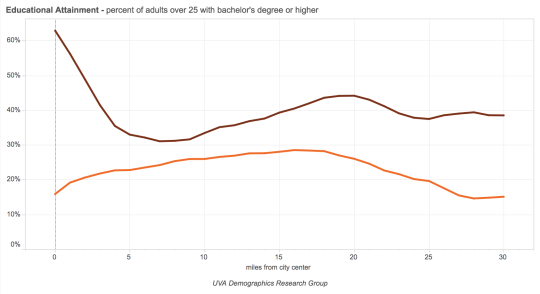
    Below is a chart that shows the percentage of adults (over 25) with a bachelor’s degree (or higher) sorted by distance from the city center. This particular chart is a composite of 7 northeastern (US) cities. The brown line is 2012 and the orange line is 1990.

    As you can see, there has been a huge spike in educated people living in city centers – at least in the northeast.

    Here is that same chart for Atlanta:

    New York:

    In the case of New York, it looks like the entire city just became more educated.

    Miami:

    Educational attainment is often the single biggest determinant of income. So there is something to be said about highly educated people concentrating themselves in city centers. We may not want to call it an inversion of great proportions, but it’s a meaningful shift.

  • The Shinola Hotel, Detroit

    Hotels play such an interesting role within cities. They are public-facing in a way that many other uses are not and they invite a mixing of different people – everyone from transients to locals. It is therefore no surprise that they can serve a variety of different roles. They can be cultural hubs. But they can also be places in which to misbehave.

    When the Drake Hotel opened up on the west side of downtown Toronto in 2004, I remember it feeling far out. It was on the edge of that which was interesting at the time. But it quickly anchored West Queen West with its cultural and nightlife offerings. And today, we could be about to see the exact same story repeat itself in the east end with the new Broadview Hotel.

    It’s for these reasons that I was both excited and curious to learn that Bedrock (real estate company) and Shinola are in the midst of launching a new boutique hotel concept in Detroit. It is called The Shinola Hotel. It will be located at 1400 Woodward Avenue. And it will be all about the city of Detroit. They expect it to open sometime in the fall of 2018.

    What I am about to say may be an availability bias talking, but there seems to be a push by many companies into the hotel space. In 2015, Equinox Fitness announced that it would be opening its first hotel in 2018 at Hudson Yards in New York. And just last month furniture retailer West Elm announced that it would be opening a first set of hotels in both Savannah and Detroit. (Go Detroit!)

    West Elm sells furniture. Equinox operates gyms. And Shinola makes and sells watches, bikes, and leather goods. But all of them are now in the hotel space. What other new hotel brands have I missed?

    Image: Shinola

  • Low-rise vs. high-rise

    Yesterday I sent out this tweet, which included this graph:

    The chart is from Altus Group and it is a monthly price index of new low-rise vs. high-rise housing in the Greater Toronto Area (GTA). I have posted similar charts in the past, but every time this chart gets updated the spread widens and the market looks even crazier.

    Some people responded on Twitter by saying that this is clearly an indication of a bubble. I don’t know if that is the case. 

    But, as I have said many times before, I do believe that it tells a vivid story around supply. Low-rise housing is severely supply constrained in the GTA and high-rise housing is less so. That has helped to stabilize pricing in the latter case.

    Now, you could look at this chart and say that the pace of low-rise price increases is simply unsustainable. The market must correct. 

    But you could also look at it and say that the market is going through a fundamental shift whereby more and more families will start living up, as opposed to out – which should then translate into high-rise pricing trending upwards as unit sizes increase. This is where I think we are headed. 

    What do you reckon is happening?