Daily insights for city builders, delivered every morning at 6 AM ET. I’m Brandon Donnelly — a Toronto-based real estate developer and founder of Globizen. I’ve been writing here since 2013.

Month: June 2016

  • The urban wealth pendulum

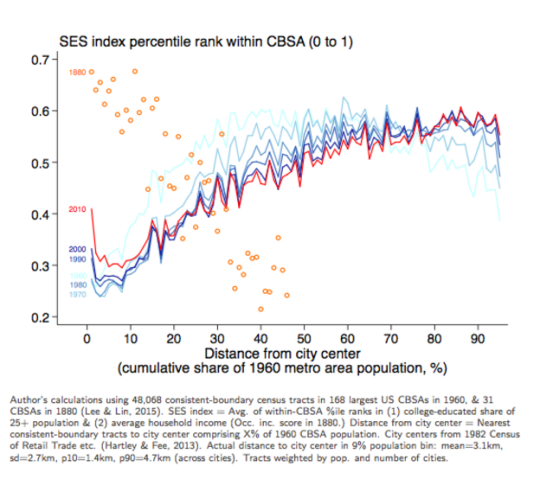
    Jeffrey Lin, who is an economist at the Federal Reserve Bank of Philadelphia, recently published the following chart:
    image

    I found it in this Washington Post article. And it’s packed full of fascinating information.

    The chart compares the socioeconomic status in US cities (y-axis) against “distance from city center” (x-axis) in 1880 and then in recent years (1960 to 2010 census data). The orange circles represent the 1880 data and the red and blue lines represent the recent census data.

    What this chart and research tells us is that in 1880, rich people overwhelmingly lived in the center of cities. And as you moved further away from the city center, socioeconomic status fell off pretty precipitously. This makes sense given that, at the time, it was hard to get around and travel long distances.

    However, in the post-war years, the exact opposite became true. We began driving and wealth decentralized. This should surprise no one. 

    But what’s interesting is how this appears to be reversing. In 2010 (the red line), there’s a sharp increase in socioeconomic status for people living basically right in the center of cities. And for the 30 – 60 km range, there has been a decrease in socioeconomic status essentially from the 1960s onwards. 

    The important takeaway here – which is spelled out in the Washington Post article – is that the neighborhoods which appear to be in high demand today are also in very short supply:

    “We have 80 years of essentially zero production of neighborhoods with these qualities,” Grant says. “We’ve spent the last 80 years building car-oriented suburbs. Then when the elites decide they want to go back into the city, there’s not enough city to go around.”

    This is one reason why supply matters.

  • Visions of urban living

    This apartment is such a great idea:

    Let me explain.

    Freunde von Freunden (FvF) is a Berlin-based publication that documents inspiring people from creative and cultural backgrounds. If you don’t read their stuff, I think you should. Sample: Here’s an interview with Chang Lin. He is Creative Director at Zalando and lives in Mitte, Berlin. I always find it fascinating to see how people live.

    In 2014, FvF decided to bridge the online and offline worlds and open up their first “apartment” in Berlin. They refer to it as: The FvF Apartment – Visions for Urban Living. And they describe it like so:

    “The apartment has been designed to be fully adaptable to the diverse and often unexpected scenarios of everyday life, reflecting how a creative, mobile and digitally-oriented generation lives. It serves not only as a platform for innovative products from friends and partners, but as a unique venue for events, workshops, and presentations.”

    Basically, the space serves as one part apartment and one part venue. They have used it as a pop-up shop, as a stage for photo and film productions, as a place for distillers to host private tastings, and the list goes. 

    Again, I think this is such a great idea as a brand extension. It is giving me all kinds of ideas and so I thought I would share it with you all today as well.

    Image: The FvF Apartment

  • Building new, better cities

    Earlier today my friend Saadat sent me the following tweet:

    //platform.twitter.com/widgets.js

    It’s a link to a new research project by Y Combinator – the famed Silicon Valley seed accelerator. They want to explore the possibility of building new and better cities.

    I don’t have the time for something like this, but if any of you are city experts (I know a lot of you are) and you’re based in or willing to be based in San Francisco (I think they are flexible on this), you should absolutely consider applying to be their full time “Cities Researcher.” The deadline is July 30, 2016.

    Here’s a taste of what they are thinking about…

    There are many high-level questions we want to think through, for example:

    – What should a city optimize for?

    – How should we measure the effectiveness of a city (what are its KPIs)?

    – What values should (or should not) be embedded in a city’s culture?

    – How can cities help more of their residents be happy and reach their potential?

    – How can we encourage a diverse range of people to live and work in the city?

    – How should citizens guide and participate in government?

    – How can we make sure a city is constantly evolving and always open to change?


    And there are tactical questions we want to dig into, for example:

    – How can we make and keep housing affordable? This is critical to us; the cost of housing affects everything else in a city.

    – How can we lay out the public and private spaces (and roads) to make a great place to live?

    – Can we figure out better zoning laws?

    – What is the right role for vehicles in a city?

    – Should we have human-driven cars at all?

    – How can we have affordable high-speed transit to and from other cities?

    – How can we make rules and regulations that are comprehensive while also being easily understandable?

    – Can we fit all rules for the city in 100 pages of text?

    – What effects will the new city have on the surrounding community?

    The convergence of city building and tech is something that I’m deeply interested in. I also think it’s inevitable. And I think that Toronto – thanks to our robust real estate industry – is in an ideal position to be a leader in this space. So I would love to see someone from here take on this job.

    But even if you’re not from Toronto, you should still apply because it’s an exciting initiative 🙂

  • Positivity at a public meeting

    I’ve been reading the blog 5 Kids 1 Condo for, I think, about a year now. It’s written by Adrian Crook who is a single dad of 5 kids, living in a 2 bedroom condo in downtown Vancouver. And his blog is about just that.

    A few days ago he posted a video of himself speaking at a public meeting in support of a new purpose-built rental building at 18th and Commercial Drive in Vancouver. The proposal includes 110 secured market rental units; 37% of which will be 2 or 3 bedroom apartments. (More information on the project, here.)

    It’s rare to see people come out in support of a project at a public meeting. Usually people only show up when they’re grouchy and upset. So today I’d like to share his speech (click here if you can’t see the video below).

    [youtube https://www.youtube.com/watch?v=q-ENWu__HdM?rel=0&w=560&h=315]

    I’m curious to know what was shouted right at the beginning after he said that he was in favor of the proposal. I listened a few times but couldn’t figure it out. 

    In any event, Adrian’s speech touches on a number of important points that transcend this specific development proposal and that are relevant to many of the topics that we discuss here on this blog.

  • This building is shit. Or is it?

    I was looking through my photo archive this past week (which is all on an Apple Time Capsule) and I came across this photo:

    I took this photo in the winter of 2011 on a snowboarding trip to Lake Tahoe. It’s of the San Francisco Federal Building, which was designed by Morphosis and completed in 2007.

    The reason this photo stands out for me is because as my friends and I were taking photos of this building a man walked by us and said:

    “Why are you taking photos of this shit?

    …you guys must be architects.”

    To me this was a frank reminder that the designs that my architecture friends and I obsess over (at least the contemporary stuff) often go completely unappreciated by a lot of other people – perhaps the majority of people.

    This, of course, raises an interesting debate. 

    If the majority of the public think a building is shit, is it a failure? Should a building’s success be judged more by how its occupants feel about it? Or is it the “expert” opinion that really matters? (Expert is in quotations because I don’t like this term.)

    While important, I don’t think it’s as simple as these questions. Architecture can take years, decades, or even longer to settle in and become fully appreciated. Think about the buildings that your city may have demolished in the past but now regrets. Tastes change.

    With that, below is an excerpt from the architect’s own description of the Federal Building. Keep in mind that this project started construction in 2003 and so design would have started years before that. Hopefully it’s clear just how relevant the ambitions of this project remain some 15 or so years later.

    The re–definition of circulation and vertical movement paths provides opportunities for chance encounters, a critical mass in circulation, and places for employees to gather across the typical confines of cubicles, departments, or floor plates. The democratic layout locates open work areas at the building perimeter and private offices and conference spaces at the central cores. As Gladwell’s article points out, “…one study after another has demonstrated [that] the best ideas in any workplace arise out of casual contact among different groups within the same company.” Skip stop elevators, sky gardens, tea salons, large open stairs, flexible floor plans, and the elimination of corner offices endow the tower with a Jacobsian “sidewalk life” of cross-sectional interactions.

    Many of the same design decisions that create high quality workspace also maximize energy efficiency. The Federal Building is the first office tower in the U.S. to forgo air-conditioning in favor of natural ventilation. As a result of the tower’s narrow profile and strategic integration of structural, mechanical and electrical systems, the building provides natural ventilation to 70% of the work area in lieu of air conditioning, and affords natural light and operable windows to 90% of the workstations. A folded, perforated metal sunscreen shades the full-height glass window wall system and a mutable skin of computer–controlled panels adjusts to daily and seasonal climate fluctuations. With an energy performance that surpasses the GSA’s criteria by more than 50%, the project sets new standards for applications of passive climate control, while physically democratizing the workplace and enhancing employees’ health, comfort, and sense of control over their environment.

  • How the UK voted

    For some reason, I woke up extra early this morning, well before my alarm. As soon as I came to and noticed the time, I immediately reached for my phone to pull up Twitter and see what happened with the UK referendum. And frankly, I was shocked to see that they had voted to leave the EU. 

    Once I saw what had happened, I then went to my computer and started looking for maps of the voting results. 

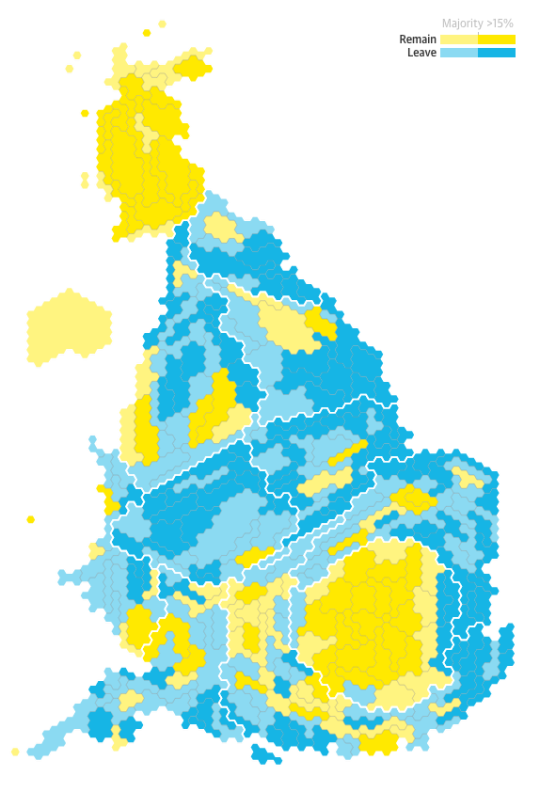
    Here’s one from the Guardian:

    image

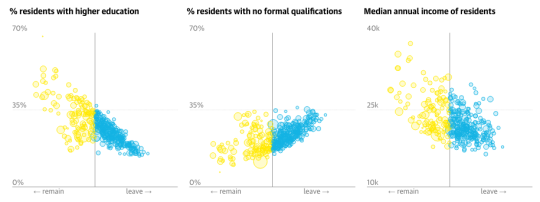
    They also found that the best predictor of how people voted (with Scotland being a bit of an exception) was whether or not they had a degree. Residents with higher education were more likely to vote “remain.”

    image

    Here’s another vote map from the Telegraph, broken down by 12 regions:

    image

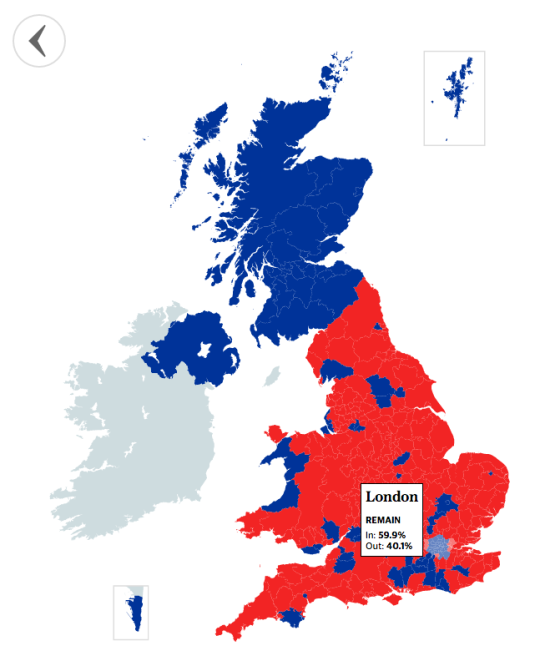
    According to these regions, only Northern Ireland, Scotland, and London voted to remain. If we get a bit more granular though, the map turns into this:

    image

    Not surprisingly, it is London and other big cities (remain) vs. the rest of England (leave). Here’s another case of urban divide.

  • Market vs. subsidized

    Miriam Zuk and Karen Chapple of the University of California, Berkeley, recently published a research brief called Housing Production, Filtering and Displacement: Untangling the Relationships

    It’s a nuanced look at the impact of both market-rate and subsidized housing production on affordability and displacement within the San Francisco Bay Area.

    The report is essentially a response to the debate around whether increasing market-rate housing production alone can address affordability and displacement concerns, or whether the only way to do it is through subsidized housing. What they found was that both matter, but…

    “What we find largely supports the argument that building
    more housing, both market-rate and subsidized, will
    reduce displacement. However, we find that subsidized
    housing will have a much greater impact on reducing displacement
    than market-rate housing. We agree that market-rate
    development is important for many reasons, including
    reducing housing pressures at the regional scale and housing
    large segments of the population. However, our analysis
    strongly suggests that subsidized housing production is even
    more important when it comes to reducing displacement of
    low-income households.”

    If you’re interested in this topic, I recommend reading the full brief. It’s only 12 pages. I particularly liked the information around filtering and how new housing steps down over time to ultimately serve lower-income households.

  • Writing every day

    I often get asked about my daily routine and how I manage to write, every, single, day.

    Oftentimes people will say that I must not sleep. But the reality is that I love sleeping and I generally need a lot of it. I’m not someone who can function on 5 or 6 hours. I’m useless with that amount of sleep. One of the best productivity hacks for me is to simply sleep more and work less.

    In terms of when I write, my preference is to write first thing in the morning – even though I don’t consider myself much of a morning person. I like to wake up, make breakfast and a coffee, and then sit down at my desk to both read and write. I like to do this before diving into email, before thinking about all the stuff that I need to do that day, and before going into the office.

    Some days a post might take me 20 minutes and some days it might take me an hour. Where I struggle the most to write every day is when I’m traveling or when I have to be somewhere super early, which then means I’m writing in the evening. I like my routines.

    I’m thinking about this right now not only because I often get asked this question, but because I’m currently making my way through a book by Adam Grant called Originals

    Though talent still matters, one the things he argues is that creative people tend to be creative because they are prolific. They produce a lot of whatever it is they do. And while much of it may be crap – he argues that Shakespeare penned a lot of crappy plays – it is through sheer volume that they end up achieving those creative breakthroughs.

    This goes against the traditional notion of the “creative genius”, but I think there’s a lot of truth to it. It’s why good architects will iterate through many different building designs and it’s (partly) why bloggers like myself see value in showing up every day.

  • The Scarborough Subway Extension is a mistake

    Last weekend over dinner, a friend of mine asked me what I thought about the Scarborough Subway Extension debate going on in Toronto right now. Costs are coming in higher than initially projected and the usual back and forth is taking place. Transit blogger Steve Munro has a good post on this called Spinning a Tale in Scarborough.

    I haven’t written much about the Scarborough Subway, but I do have a strong opinion. I believe it’s a mistake. I am not saying that we shouldn’t be building higher order transit in Scarborough – we absolutely should – but it does not need to be an expensive subway line. There are more sensible solutions.

    Here are a few things to consider:

    Light rail transit (LRT) does not equal streetcar. As an avid user of the King streetcar, I’ll be the first to admit that something needs to be done to address the city’s busiest streetcar routes. They are broken. But this is not what was being previously contemplated for Scarborough. True LRT – which Toronto does not yet have – is far more effective at moving people.

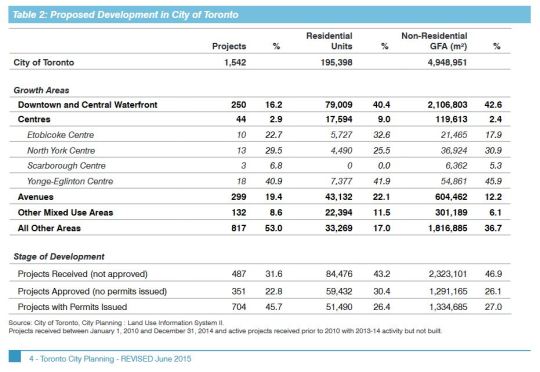
    Scarborough Centre is seeing almost no new residential and commercial development. In fact, the “Centres” in general are not seeing much development. The largest share is happening downtown, along the central waterfront, and along the “Avenues.” We shouldn’t ignore this when making our investment decisions. Transit and built form go hand in hand. 

    I also do not buy the argument that we are building this subway in anticipation of demand 50 or 100 years from now. We are not in a position to be proactive about our infrastructure. We are desperately playing catch up and there are already lots of high growth and high density areas in the city which today are completely underserved by higher order transit. 

    Finally, a new subway line with low ridership will mean higher operating cost subsidies to keep it afloat. And at the rate that Scarborough Centre is growing today, this would likely continue for many years into the future. Not only is this debate about spending money today, it is about spending money well in the future, month after month.

    So let’s be clear: the Scarborough Subway Extension debate is about politics. It is not about transportation planning.

  • A Love Letter to the Great Lakes

    This week, the first ever international street art festival will be taking place in Toronto. It’s called A Love Letter to the Great Lakes and it is running from June 20 to June 25, 2016.

    The goal of the festival is to use public works of art to get people thinking about our water resources and, more specifically, about the Great Lakes. Together, these Lakes represent 20% of the world’s fresh surface water.

    So this week, 21 local and international artists will be painting giant murals in 3 different areas of the city: Queen & Ossington, Queen & Spadina, and at the mouth of the Don River.

    The collaborators for the event include Tre Packard (Pangeaseed Foundation), Jason Botkin (A Love Letter to the Great Lakes, En Masse), Jaqueline West (Herman & Audrey), developer Jeff Hull (Hullmark) and Devon Ostrum (Friends of the Pan Am).

    Below is one of the works already in progress. It’s by Jason Botkin and it’s located on one of the bents of the Gardiner Expressway East at the mouth of the Don River.

    image

    This event caught my attention for 3 reasons.

    First, I think the city is going to be left with some rad looking murals. Here is one from a similar event in Cozumel, Mexico called Sea Walls: Murals for Oceans in Cozumel:

    image

    Second, like many others, I care deeply about the environment. But until we put in place the right economic incentives / disincentives, we need all the awareness building that we can get.

    Third, seeing Jeff Hull on the list of collaborators reminded me that there’s a new breed of real estate developers emerging in our cities. The big bad developer is sometimes (often?) thought to be greedy and insensitive to local communities. But I think the next generation sees itself quite differently. They see themselves more as city and community builders.

    So if you’re in Toronto this week, get on your bike and head over to one or more of the mural sites. Tweet me if you decide to go and maybe we can connect.