Daily insights for city builders, delivered every morning at 6 AM ET. I’m Brandon Donnelly — a Toronto-based real estate developer and founder of Globizen. I’ve been writing here since 2013.

Month: May 2016

  • Towards car-free living

    Right now, there’s an apartment building in San Francisco that is trying to encourage car-free living by offering residents a $100 per month credit that can be used for Uber and/or for public transit. Prospective residents can even get a $20 credit to go check out the community. (The program is a partnership with Uber.)

    The reason this leasing strategy caught my attention is because we’re at a point where city builders are now trying to recalibrate themselves to this new emerging world. 

    When I was at the Land & Development conference earlier this month, one developer brought up this exact point. He more or less asked: If you’re starting development on a new building today and you’re expecting approvals in 2 or so years and completion in another 3 or 4 years, what do you think the state of cars/driving will be at that point? Should you really be building all that underground parking?

    These are great question. And they highlight one of the challenges of development. It takes a long time to bring new supply to the market and a lot can change during that time period. My sense is that we are pretty clearly seeing downward pressure on driving and car ownership.

    That said, this isn’t the case in every city or in all parts of a particular city. I just got back from a trip to a Detroit where it’s pretty hard to imagine the city being oriented around anything but the car. But in cities like San Francisco and Toronto, car-free living is already a reality for many people and so we need to respond to that.

    How do you see yourself driving, or not driving, in the next 5 to 10 years?

  • The answer to San Francisco’s housing affordability problem

    Blogger and programmer Eric Fischer has an excellent post up on his site where he looks at: “Employment, construction, and the cost of San Francisco apartments.” It’s worth a good solid read.

    What he did was dig deep into whatever data he could find – the data goes back to the beginning of the 20th century in some cases – to try and figure out a solution to San Francisco’s housing affordability problem.

    Many (including myself) have argued that, at least part of the solution, is to build more, not less, housing. However, others, such as Tim Redmond of 48 Hills, have argued that building more market-rate housing would simply exacerbate the current situation.

    In Eric’s analysis, he looked at everything from median rents and new housing units constructed (above graph) to annual wage growth and income inequality. I particularly liked his summary of the city’s various building booms. 

    In the end, here’s the conclusion that he came to:

    “In the long run, San Francisco’s CPI-adjusted average income is growing by 1.72% per year, and the number of employed people is growing by 0.326% per year, which together (if you believe the first model) will raise CPI-adjusted housing costs by 3.8% per year. Therefore, if price stability is the goal, the city and its citizens should try to increase the housing supply by an average of 1.5% per year (which is about 3.75 times the general rate since 1975, and with the current inventory would mean 5700 units per year). If visual stability is the goal instead, prices will probably continue to rise uncontrollably.”

    By visual stability, he is referring to maintaining the current urban fabric of San Francisco just the way it is. In other words, he is making the link between preservation and affordability in a prosperous and growing city.

    Intuitively, this makes sense to me. It’s unrealistic to think that you can maintaining some level of housing affordability without allowing supply to increase alongside demand.

    At the same time, I do not believe that preservation needs to equate to no changes whatsoever. Urban preservation, to me, should be about dutifully respecting the past while still looking firmly towards the future. And that’s how I believe successful should be approaching this problem.

  • Photoblog: Cranbrook Schools

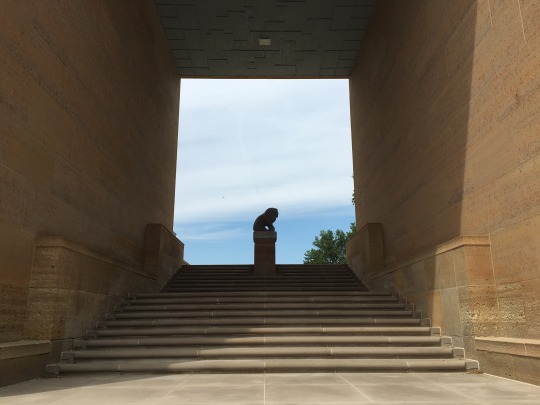
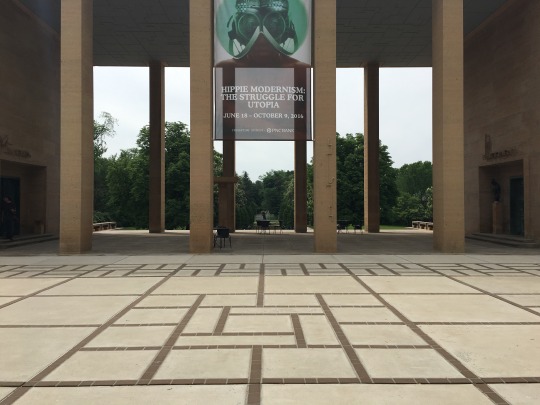
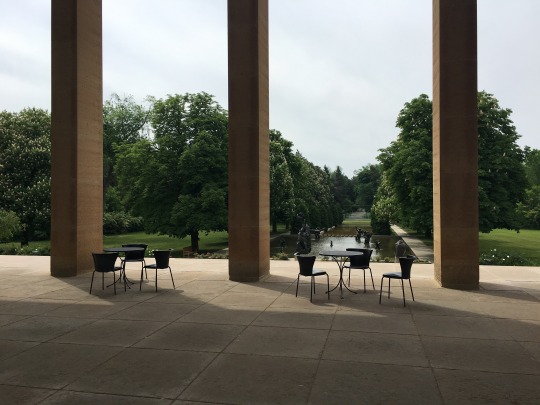
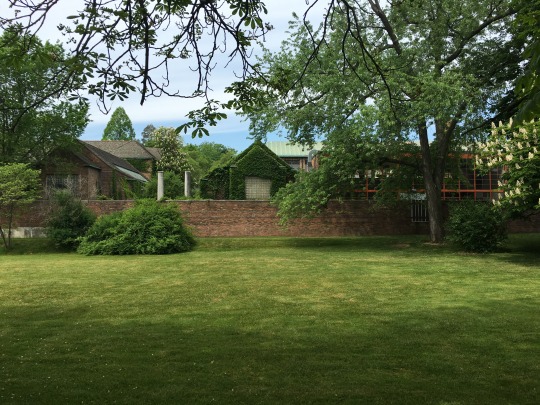
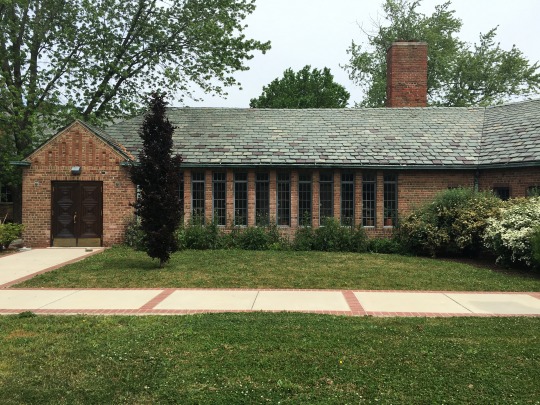
    My spring allergies have gotten the best of me today. So instead of a regular post, I’m going to share some of my photos of the Cranbrook Schools. I toured the campus this afternoon.

    Cranbrook Schools is a private boarding school (PK – 12) in Bloomfield Hills, outside of Detroit. It has an endowment fund of about $233 million, which is one of the largest of American boarding schools. In 1989, the campus was designated a National Historic Landmark.

    The photos are in the order in which they were taken.

    A man happen to be playing a violin in the space below.

    The stone shingles below get smaller as they move up the roof to give the illusion that the building is larger than it really is.

    And here are my fellow architecture nerds, Matthew and Rick.

  • Buy or build?

    image

    I’m in Detroit right now.

    I’m staying in a nice neighborhood where you can buy a 2,000 sf house on a 6,000 sf lot for about US$125,000. A house double the size, at around 4,000 sf, might run you US$350,000.

    In comparison, a new underground parking spot in downtown Toronto could cost you around CDN$60,000. And a small 1 bedroom apartment, could easily run you the same price as the above 4,000 sf home.

    These are two completely different real estate markets.

    What’s happening in Detroit is that many/most of the houses are being valued at below their replacement cost, which means it generally doesn’t make sense to build new. Why take on the risk of building when you can buy for less?

    Oftentimes this a decision that real estate companies will face: buy or build? Depending on the market, the answer could be very different.

  • Architect Profile: Omar Gandhi

    image

    This week – thanks to an introduction from a mutual friend – I had the pleasure of having lunch with architect Omar Gandhi. 

    Based in both Halifax and Toronto, the Globe and Mail has called Omar one of Canada’s next top architects and Wallpaper Magazine has named him one of the top 20 young architects in the world. So if you haven’t yet heard of him, consider this post as your heads up.

    What’s exciting about his work is how it really reflects the ethos of the places he works in (east coast Canada in many cases). At the same time though, his works seems to define a new modern and Canadian design sensibility. 

    And this is what I believe great architecture should do. It should respond to and reinforce local cultures, but also help to shape them as they invariably evolve. Architecture and culture are inextricably linked.

    I love seeing local talent thrive, so I hope you will take a minute to visit Omar Gandhi’s website.

    Image: Modern Cabin in Cap Breton from OG

  • Should Switzerland adopt an unconditional basic income guarantee?

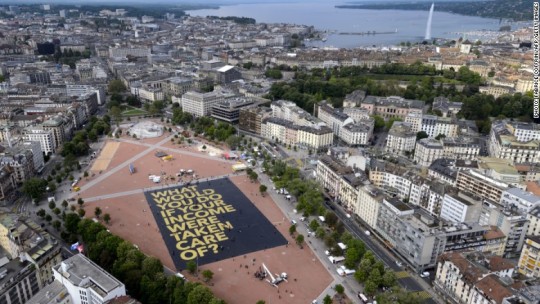
    On June 5, 2016, Switzerland will become the first country to hold a national referendum on the introduction of an Unconditional Basic Income. The proposal is essentially an income guarantee that would ensure everyone in the country is paid a minimum after-tax amount of 2,500 Swiss francs per month.

    The idea is that this would replace various other social programs. But unlike traditional welfare, people would be allowed to work. If you happened to be making less than 2,500 Swiss francs per month, then you would simply get topped up to ensure you hit this minimum income level.

    Supporters believe that a dramatic rethink of income redistribution is needed in our current information economy where income inequality is rising and productivity gains don’t seem to be getting applied evenly. 

    There is also an argument that a basic income guarantee could encourage more entrepreneurship. If we didn’t need to work, would more of us start a company and/or pursue our passions?

    Personally, I’m not sure about an income guarantee. It’s difficult to predict the broader impacts. But it’s worth exploring and many people – are various ends of the political spectrum – are doing just that. (Additional reading material can be found here, here, and here.)

    I haven’t made up my mind on this topic, so I would be curious to hear your thoughts in the comments below.

    Image: CNN Money

  • The Storefront Index

    The folks over at City Observatory have recently developed something called The Storefront Index

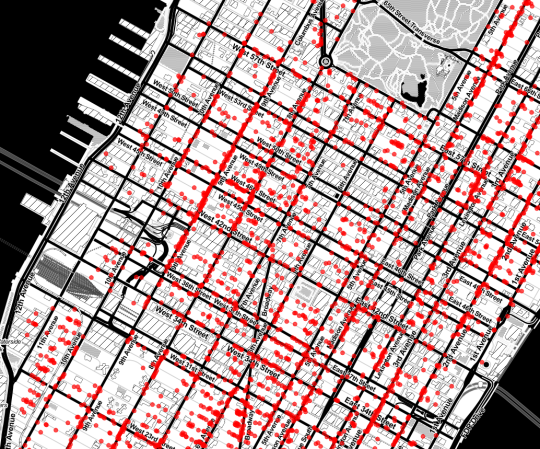
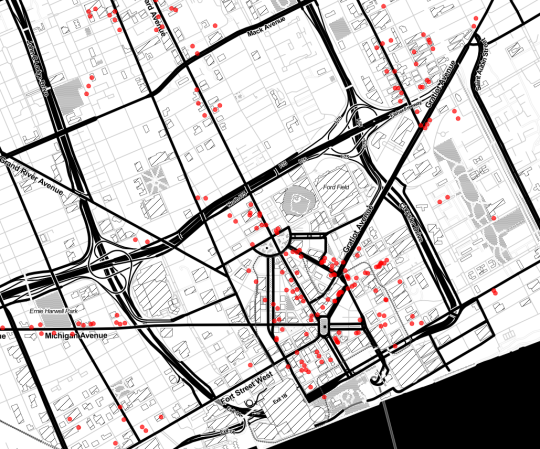
    It is a mapping of “clustered” consumer-facing storefront businesses across the 51 largest cities in the United States and within a 3-mile radius of their CBD. (Their definition of cluster is that the business is located within 100m of another business.)

    At the top of this list is New York (no surprise here) with 9,905 storefronts and at the bottom of this list is Detroit (probably no surprise here either) with 411 storefronts. On average, they found that the “typical” city has about 900 storefronts within this 3-mile radius.

    Here’s a screenshot of New York:

    image

    And here’s a screenshot of Detroit:

    image

    They should be at the same scale.

    If you’d like to read their Storefront Index Report, you can do that here. And if you’d like to explore their interactive maps, you can do that here. City Observatory has made all of this available as a free tool for city builders – which is really great to see. (You can even download their shapefiles if you’re into that sort of thing.)

  • Towards decentralized city building

    One of the
    most profound shifts taking place today – because of new technologies – is
    that of decentralization. I’ve written about this before, but I keep coming
    back to it because I find it so fascinating.

    It’s
    happening to varying degrees, but as a general trend, I believe it is leading
    to better data (less information asymmetries), more efficient markets, and the
    removal of many middle people. In the past, some intermediaries were necessary in
    order to act as proxies for portions of the market. But I believe that is
    changing.

    So what’s
    an example of this? Bitcoin. Bitcoin is an example of decentralization because
    no one entity controls it. It operates through a decentralized public ledger.
    And because of this, it has the potential to be highly disruptive to the way we
    think about currencies today.

    Put another
    way, I see decentralization as a way to leverage the wisdom of crowds. I am
    convinced that large groups of people can be incredibly intelligent when they’re
    allowed to contribute in the right ways. And I think this could solve many
    different problems, from the infighting we see within cities to broader market phenomena.

    As another example,
    there’s something new in the venture capital space called DAO – which stands
    for Decentralized
    Autonomous Organization
    . Essentially it’s a decentralized VC platform based
    off of a Bitcoin derivative currency.

    But perhaps
    the most noteworthy and relevant feature is that it allows its large pool of
    investors to anonymously vote on which investments to pursue. This is in
    contrast to a more centralized approach where an investment committee would
    meet behind closed doors in a big boardroom and make a decision. This would be the
    more typical approach.

    If you’re
    not in the tech space, the above may not seem all that exciting to you. But I
    see many parallels between venture capital and real estate development, which is
    one of the reasons I follow the space. So I can’t help but wonder what this
    trend could ultimately mean for real estate, design, and other city building industries.

    I can
    certainly imagine a world where the forces that shape our cities are more
    collective and decentralized in nature. It’s already starting to happen through crowdsourcing, social media, ridesharing, and other online platforms.

  • On leadership

    Venture capitalist Mark Suster has a great post on his blog called: Lead, Follow or Get the Fuck Out of the Way. It’s a relevant read no matter what kind of organization you happen to be a part of. I think the lessons are universally applicable.

    Here are two paragraphs on leadership that I really liked:

    The problem with hard decisions is that you can never make everybody happy. There is always somebody impacted or somebody who thought “plan B” was better. Leadership is about listening to multiple opinions but in the end trusting your instincts and deciding. Leadership is about not worrying about how people will think about you for hard calls. It is about being willing to be wrong.

    Leaders have well-formed opinions that go against the grain, the temerity to sell their vision to skeptics, the tenacity to stick to their ideas when they are inevitably criticized, the resiliency to wake every day when they’re being kicked by everybody for their beliefs but also the willingness to look at data and re-chart their course when they got it wrong.

    In business school they teach you to privilege decisiveness over inaction. They teach you that no decision is actually a decision and that you shouldn’t wait around for the perfect solution. It’s rare to have all of the information. So make a decision and go. Sometimes, of course, this can cause problems. Mistakes will happen. But I generally subscribe to this approach. 

    One of the ways I am trying to develop these skills – which may not be obvious to some of you – is by writing on this blog every day. I’m not always happy with result. Sometimes it really pains me to hit “Post now” when I’ve run out of time and I have to get to the office. But in the grand scheme of things, that’s okay. It’s more about the discipline of putting myself out there every single day.

    Hopefully this approach creates as much value for you as it does for me.

  • In support of a super-metro

    I just got home from a couple of coffee meetings, an afternoon bike ride and an impromptu basketball shootaround. Toronto is a different place in the summer. And it feels great to be biking everywhere.

    But Toronto is more than just Toronto. Toronto is at the center of a much larger urban agglomeration. And our continued success is going to partially hinge on our ability to work together in a coordinated way.

    Greg Spencer of the Martin Prosperity Institute recently published an interesting article called: Is it time to create a super-Metro? Here’s what it’s about:

    Our research at the Martin Prosperity Institute shows that economic competition is now primarily between cities rather than countries. To be successful in this environment, Toronto and its neighbours need to find a way to erase local divisions and solve their problems together. 

    Toronto is a wildly successful city, world-class in many respects. When our current institutional arrangements were forged, no one predicted the level of growth the region is experiencing. Status quo local government arrangements cannot adequately deliver the level of co-operation and collaboration needed to cope and plan for the future.

    Greg believes that the answer is a new regional authority that could give “democratic legitimacy to the very important decisions being made for the benefit of the wider region.” 

    I’m not going to comment on how all of this should be executed, but I fully agree that we need to think and act as one consolidated urban entity.

    Cities are the economic driver of the new global economy, but many (most?) of our governance structures do not properly reflect that reality. And the risk is that we are allowing arbitrary municipal boundaries and lack of coordination to hinder our ability to compete globally.

    This goes for Toronto and it goes for every other city region around the world.