Daily insights for city builders, delivered every morning at 6 AM ET. I’m Brandon Donnelly — a Toronto-based real estate developer and founder of Globizen. I’ve been writing here since 2013.

Month: December 2015

  • 16 mobile theses and how tech might change the built environment

    Caucasian woman standing near passing subway in train station by Gable Denims on 500px.com

    https://500px.com/embed.js

    One of the things that I try and do here on this blog is examine the intersection of design, real estate, and technology. I didn’t explicitly set out to do that, but more and more I find myself thinking that way when I’m writing and when I’m giving talks.

    Part of that is because of my passions, but part of it is because there is a big and important overlap. One example of that is autonomous, self-driving cars. The tech community is enamoured with driverless cars, but everyone involved in the built environment should also be thinking about their impacts. Because it’ll be significant.

    Benedict Evans – who is a venture capitalist with Andreessen Horowitz in the Valley – recently published a post called, 16 mobile theses. It’s a look at 16 topics, trends, and shifts that are happening in the tech space. (There’s also a related podcast discussion.)

    If you’re involved in internet products, you absolutely need to give it a read. But I also think it’s interesting to read it through the lens of a designer or real estate person. Productivity is changing. Notions around the living room are changing. And yes, autonomous vehicles are going to have a profound impact on the urban landscape of our cities – just as cars did initially.

    Below are 3 excerpts from Benedict’s post that I really enjoyed.

    The first is about mobile and just how massive it is:

    “The mobile ecosystem, now, is heading towards perhaps 10x the scale of the PC industry, and mobile is not just a new thing or a big thing, but that new generation, whose scale makes it the new centre of gravity of the tech industry. Almost everything else will orbit around it.”

    The second is about how “networked” is quickly becoming a given:

    “Our grandparents could have told you how many electric motors they owned – there was one in the car, one in the fridge and so on, and they owned maybe a dozen. In the same way, we know roughly how many devices we own with a network connection, and, again, our children won’t. Many of those uses cases will seem silly to us, just as our grandparents would laugh at the idea of a button to lower a car window, but the sheer range and cheapness of sensors and components, mostly coming out of the smartphone supply chain, will make them ubiquitous and invisible – we’ll forget about them just as we’ve forgotten about electric motors.”

    And the third is about those self-driving cars:

    “The move to electric and the move (if and when) to autonomous, self-driving cars fundamentally change what a car is, but also what the whole automotive system might look like. Electricity changes the mechanical complexity of cars and hence changes who might build them and what they might look like. Autonomy and on-demand services change who buys them, meaning the buying criteria will be different. But they could also change the urban landscape just as much as cars themselves did – what do mass-market retail or restaurants look like if no-one needs to park?”

    Can you think of other ways in which tech will impact cities and the spaces we occupy?

  • I’m writing a book on becoming a real estate developer

    typerwriter closeup by Sean Gladwell on 500px.com

    https://500px.com/embed.js

    One of the most common questions I get from readers of this blog is: How do I become / get into real estate development?

    In fact, I get it so often that I’ve decided to write a book as my response. It may be a short one or it may end up a long one. If you’ve emailed or messaged me with this question and I haven’t responded, I’m sorry. There’s a lot of you out there. But I do want to help and that’s why I’ve decided to take on this hobby book project.

    As part of the book, I’ll be talking about my own journey, as well as the actual nuts and bolts of development. But I would also like to feature some much more established players in the business. In order to do that, I’ve decided to crowdsource some of the content for this book. 

    So here’s my ask to you: If you’re a real estate developer and would like to share your story, please complete this short questionnaire. You can be located anywhere in the world.

    My plan is to select a handful of developers from around the world and then feature their stories, one-by-one. I’m confident that there will be a lot of interest in hearing how successful developers established their careers and/or own businesses.

    I’ve been thinking about doing this for quite awhile now. It feels good to get started. 

  • 50% of New York City’s population is estimated to be single. Here’s what that means for housing.

    Here in Toronto there’s a push for more family-sized apartments. That’s what the planners want to hear.

    Because the city has been trying to encourage developers to build more of them for years, but the challenge has always been that they didn’t sell or that they took a long time to sell. The market wasn’t ready.

    But as I discussed earlier this week, that is starting to change. I think Toronto is reaching a tipping point where low-rise housing has simply become too expensive and people are starting to look to alternatives, mostly at the mid-rise scale.

    It’s interesting though that something of the opposite appears to be happening in New York. I don’t know enough about the New York new construction market to really comment on overall unit mixes and sizes, but there definitely seems to be a push to create more affordable micro-units.

    Curbed published this last October:

    “…a report currently under public review, called Zoning for Quality and Affordability, recommends relaxing density caps and eliminating the 400-square-foot minimum for studio apartments, thereby creating more housing for single people. Almost 50 percent of the city’s population is estimated to be single, but only seven percent of the housing stock is studios.”

    And just recently, New York completed its first all-micro-unit apartment building called Carmel Place. Rents start at $2,650 per month for a 265 square foot apartment. 

    As a point of reference, that works out to be $10 per square foot per month and more than 3x the highest rents you could reasonably achieve in the more desirable areas of Toronto, today.

    The model suite is 302 square feet and looks like this:

    All of the above photos are via Curbed.

  • The highs and lows of mid-rise

    Last week
    was developer Urban Capital’s 5th annual “Naughty or Nice” party. It’s obviously a holiday tradition of theirs and it has become a tradition of mine to attend. Judging by my vast collection of photo booth photos, there’s a chance I may have been to all of them. It’s easily one of the best holiday parties in the business.

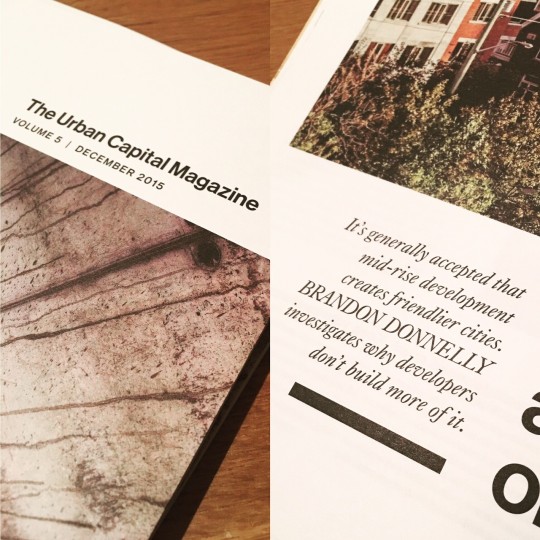
    One of the things that Urban Capital does at its annual party is release its annual magazine. And this year I was fortunate enough to be invited to write a piece for it on the highs and lows of mid-rise development. Put differently, it’s about the challenges facing developers who want to build mid-rise, but also why they’re pretty great for cities.

    If you’d like to have a read, you can do that online by clicking here. And if you’d like to receive a hard copy of the magazine, I can make that happen as well. Tweet at me. Alternatively, you can also pick up the magazine at any Urban Capital sales office.

    I deliberately tried to make it so it wasn’t your typical real estate puff piece: condos are great, yada, yada, you should buy one from us. I tried to make it an intelligent piece on some of the real challenges facing mid-rise developers. And that’s what Urban Capital wanted as well. I hope you enjoy it 🙂

  • Changing Lanes — A fireside chat with Jennifer Keesmaat and Janette Sadik-Khan

    Citi Bike by Pete  on 500px.com

    https://500px.com/embed.js

    When I was in Miami at the beginning of this month I missed an interesting event that I normally would have attended. It was a conversation between the Chief Planner of Toronto, Jennifer Keesmaat, and the former commissioner of the New York City Department of Transportation, Janette Sadik-Khan.

    Sadik-Khan was appointed under the Bloomberg administration and quite famously oversaw a huge number of urban changes in New York. Projects such as the addition of hundreds of kilometers of new bike lanes and the creation of 60 new pedestrian plazas across the city – including the one in Times Square.

    I was bummed I couldn’t attend, but thankfully Keesmaat wrote a post on her blog following the event and the Metcalf Foundation shared videos of the conversation. 

    Here’s a piece that I liked from Keesmaat’s blog post:

    “But she also pointed out that when they demonstrated what could be done, when they quickly mobilized around action, residents clamoured for similar changes in their neighbourhoods. Not surprisingly, this is why her book is called Streetfight – because it is a fight. City building is often the battle of ideologies, and when you’re trying to change the status quo, there is always a significant demographic of the population that is fully committed to maintaining business-as-usual.”

    If you have some time, you can also click here to watch the videos. There’s about an hour and a half worth of video, so you might want to open up a bottle of wine or something.

  • Why multi-family developers are shifting their customer focus

    One aspect of the Toronto housing market that I’ve been paying close attention to is the adoption of multi-family dwellings by both long-term end-users and families. 

    I’ve written about this before (here and here, over a year ago) and have argued that here in Toronto we are at an inflection point. Multi-family dwellings – both rental and condo – are evolving to now target these new customer segments. Whereas previously, the new construction multi-family housing market was heavily geared towards investors and first-buyers. And often it was simply a stepping stone towards a single family home.

    Now, every city and real estate market is different. And I have heard many people in U.S. cities say that Millennials are simply deferring what we saw with previous generations. At the end of the day they (or we, I’m a Millennial) are going to move to the suburbs and buy that car. The current trends we are seeing around city living and reduced driving are just that – short-term current trends.

    But I think it’s worth reiterating: I do not believe that the status quo is what’s happening right now in Toronto. And I’m sure it’s also happening elsewhere. Time and time again I speak to developers in this city who are starting to shift at least some, and in some cases all, of their focus towards end-users, families, and larger units – particularly for new mid-rise product in the “neighborhoods.”

    And if you think about it, this makes perfect sense. 

    The average price of a detached single family house in Toronto is well north of a million dollars. So when a developer brings to market a 1,200 sf family sized apartment at $600 psf ($720,000) or even at $700 psf ($840,000), that home now becomes a relatively “affordable” option in many desirable areas of the city. Particularly if you value location amenities and your time (i.e. shorter commutes) over raw quantity of space. I know I certainly do.

    I know this isn’t going to appeal to everyone. But there is a big market here. Get ready.

    What are you seeing in your city? Let us know in the comment section below.

  • [Video] The Skyline Forum: Architect or Developer?

    I recently had a discussion with Ben Stevens about architecture and real estate development for his video blog, The Skyline Forum. I’ve posted about his blog before because I think it’s a great idea and a great forum for the industry. I sure hope he keeps it up.

    Here’s what we talked about in Ben’s words:

    “In Episode 6, I caught up with Brandon Donnelly of the very popular blog Architect This City. Brandon has degrees in both architecture and real estate development and as such has a unique perspective on the two disciplines. In this episode, I was interested to hear about the rationale behind his decision to pursue development over architecture, his definition of “real estate developer,” and his suggestions for pursuing the kind of work in real estate development which he does (currently in Toronto). It was a great conversation and confirmed for me a lot of things I’d learned through reading his fantastic blog.”

    And here’s the video discussion:

    [youtube https://www.youtube.com/watch?v=_-o_gT9czfM&w=560&h=315]

    A big thanks to Ben for inviting me to participate – he has chatted with some big names. As a published author himself, I also appreciated him encouraging me to write a book. I’ve been thinking about doing that. Oh, and a big thanks to my mom for providing the Christmas poinsettia that ended up being prominently featured in the background 😉

    I haven’t watched the full video yet, but one thing is clear: I’m quite the hand talker.

  • The value of absurdity for innovation (and a story about tacos)

    Vegan tacos by Karolina Wiercigroch on 500px.com

    https://500px.com/embed.js

    “Great ideas alter the power balance in relationships. That’s why great ideas are initially resisted.” –Hugh Macleod

    I have been following the work and writing of designer Tobias van Scheider for quite some time now. If you don’t subscribe to his newsletter and you end up liking this post, you should consider signing up.

    Recently I stumbled upon something he published back in October called “Ignore Everybody”, where he argues that when you’re exploring something new – that could potentially fail – one of the best things you can do is ignore everybody. 

    And that’s because:

    “We have to understand that ideas are by nature very fragile. They’re like little naked babies, unable to protect themselves. If we really believe in a new idea, we have to protect her with great effort. This is difficult, because oftentimes the greatest ideas get killed by the people around us. Executing on a great idea is by nature a lonely path. If everyone would agree with you, the idea is probably not that great anyway.”

    I am incredibly interested in how new things get started and how new ideas thrive. Fostering innovation has become a critical component of city building in today’s world. But sometimes I feel as if we’re thinking too top-down, as opposed to bottom-up. 

    As Tobias rightly points out in his article, lots of great ideas started as stupid little projects. Who would have thought that a teen sexting app with disappearing messages (Snapchat) would become a company worth many billions of dollars?

    It’s for this same reason that Sam Altman of Y Combinator recently wrote that sometimes its better to call your new company a project, rather than a business. When you call it a business you impose all kinds of biases onto it in terms of viable business models, and so on. But when you keep it a “project”, it becomes more acceptable to be experimental.

    As an example of all this, I was fascinated to learn this past weekend about a Toronto-based ad agency called OneMethod. Because as part of their agency they have a division called the MethLab, where the goal is to simply experiment with “absurd ideas.”

    One of those absurd ideas was a social media campaign slash pop-up taco restaurant – remember, they are an ad agency not restauranteurs. It was so grassroots that they ended up having to sell original art work that happened to come with a “free” taco in order to get around all the legal requirements for serving food. Brilliant.

    The idea was so well received that it has grown into a fully fledged restaurant called La Carnita, which today operates across 3 permanent locations and happens to be one of the most popular taco restaurants in Toronto.

    But let me ask you this, if they had instead gone out to investors – as an ad agency wanting to get into the taco business – would they have been able to raise the money for their first physical restaurant? I can imagine this being a lot more difficult.

    On a larger scale, this is exactly what Google is doing with Alphabet. The company was reorganized and rebranded so that they could continue to work on absurd ideas outside of the Google cash cow. If the idea/project takes off, then it becomes a fully fledged company. If it doesn’t, then it gets shut down and something else is tried.

    This is what people and companies are doing today to stay relevant in the innovation race. 

    But in some ways it feels like a battle to allow the absurd to survive. That’s why the best approach might be to just ignore everybody. There’s value in the absurd but maybe you’re the only one who sees it right now.

  • The Entrepreneurs, Barcelona

    Last week Monocle published their latest edition of “The Entrepreneurs” series. In this episode they look at Barcelona and a handful of entrepreneurs that are helping to grow the city. The video is only about 7 minutes long.

    I enjoy Monocle’s short films and I’ve always been impressed by Barcelona as a city. So here’s the video:

    [youtube https://www.youtube.com/watch?v=Q1wLBjlecac?rel=0&w=560&h=315]

  • K-House

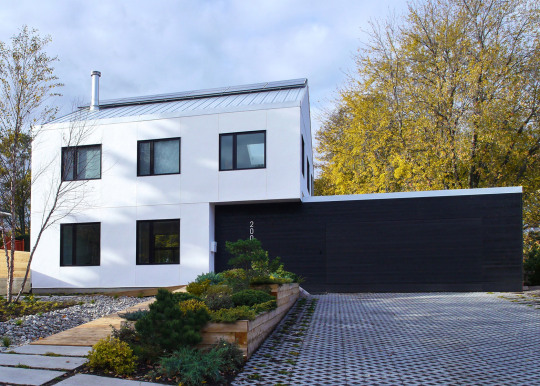
    My friend Nicolas Koff – who I went to architecture school with, twice – recently completed a house near Hamilton, Ontario. I think it’s stunning and so I wanted to share it with you all today. It was also featured in Dezeen Magazine this week. That’s where the photos are from.

    Beyond its good looks though, it’s also a great example of sustainable design. The walls were prefabricated and are 40cm thick in order to reduce energy consumption. There are also solar panels on the roof to offset some of the electrical loads. And this is just some of the sustainability strategies employed.

    Click here to see the rest of the photos at Dezeen. I hope you like it as much as I do.