Daily insights for city builders, delivered every morning at 6 AM ET. I’m Brandon Donnelly — a Toronto-based real estate developer and founder of Globizen. I’ve been writing here since 2013.

Month: October 2015

  • How we perceive commuting

    CHENNAI, INDIA-FEBRUARY 10: Street of Indian city 10, 2013 in Ch by sergemi on 500px.com

    https://500px.com/embed.js

    Wharton real estate professor, Mariaflavia Harari, recently published a paper that looks at the relationship between urban geometry (specifically compactness) and inner city commuting efficiency across 450 cities in India.

    Consistent with previous research done in this space, she finds that people generally prefer compact cities and that they are willing to pay a premium for it. It increases overall welfare. Here’s an excerpt from her paper:

    “My findings are broadly consistent with compact city shape being a consumption
    amenity. All else being equal, more compact cities grow faster. There is also evidence that
    consumers are paying a premium for living in more compact cities, in terms of lower wages and,
    possibly, higher housing rents.”

    So her recommendations for the Indian cities she analyzed was that they should relax land use restrictions to allow for more vertical / compact development and that they should focus on improving urban transport in order to offset some of the negatives externalities associated with sprawl. This is no different than the approach that many cities in the developing world are adopting or looking to adopt.

    One of things that really stood out for me in her paper though is the way people perceive commuting:

    “The loss associated with non-compact
    shape appears to be substantial: a one-standard deviation deterioration in city shape, corresponding
    to a 720 meter increase in the average within-city round-trip, entails a welfare loss
    equivalent to a 5% decrease in income. This is considerably larger than the direct monetary and
    opportunity cost associated to lengthier commutes. Less compact cities also appear to attract
    fewer low-income immigrants, as captured by the share of slum dwellers.”

    What this is saying is that we tend to overvalue the negatives of commuting, beyond the direct costs of gas, insurance, car payments, our time, and so on. We hate it so much that we also want to be compensated for the mental anguish. Here is that same idea said differently:

    The estimated welfare loss from longer commutes appears to be large, relative to the immediate
    time and monetary costs of commuting. This is consistent with the interpretation that
    commuting is perceived as a particularly burdensome activity. The behavioral literature has
    come to similar conclusions, albeit in the context of developed countries. Stutzer and Frey
    (2008) find a large and robust negative relation between commuting time and subjective wellbeing,
    using German data. They estimate that individuals commuting 23 minutes one way
    would have to earn 19 percent more per month, on average, in order to be fully compensated.

    So I guess I’m not the only one who thinks commuting and driving sucks.

  • City-to-country colonization

    Lately I’ve been feeling that we’ve been having some pretty serious conversations here on Architect This City. Everything from condominium reserve funds to housing/tax policy. So today I thought we could change it up and talk about something a bit more fun: farmhouses.

    Last weekend when I was in Prince Edward County, one of the places that I visited was the Drake Devonshire Inn. It’s been on my list for awhile, so I’m glad I finally got to experience it. It’s an outpost of the Toronto-based Drake Hotel (no relationship to Hotline Bling Drake) and they refer to it as their “contemporary farmhouse.” 

    It was stunning.

    As soon as I walked on the grounds, I couldn’t stop looking around, taking pictures, and examining all the art that they have sprinkled around the inn. Those are the sorts of things I do when I get excited by a building or place. I’m like a kid in a candy store.

    I was so impressed that after I left I had to message my friend – who worked on the project and who I went to architecture school with – to tell her that she did an amazing job. Want to see for yourself? Click here for photos of the farmhouse. And click here for information on the design firm behind the farmhouse (+tongtong).

    But beyond just a great space, the Drake Devonshire is also symbolic of something greater than seems to be taking place. Almost everybody I met in PEC seemed to be a Toronto transplant. They were done with life in the city and decided take off for the country. But along with them is coming pieces of the city. (The Hayloft Dancehall is another example.)

    I used to think that this kind of city-to-country colonization was bound to happen in Niagara-on-the-Lake, which is only about an hour west of the city. But it turns out I was wrong. It seems to be happening to the east of the city in Prince Edward County.

  • Should condo reserve fund balances be made publicly available?

    No Need For Love by Michael Muraz on 500px.com

    https://500px.com/embed.js

    I’ve been thinking a lot lately about condominium governance and how things might be improved.

    If you own a condominium, you pay a monthly maintenance fee. Let’s say, for example, you own a 833 square foot condo and your maintenance fee is $500 per month. That works out to be $0.60 per square foot.

    For a lot of people, this fee probably feels like a bit of a black hole. The money goes out every month and that’s the end of it.

    But as I explained here, a portion of that fee goes into the condo’s reserve fund to cover future capital expenditures. This is basically an investment you are making for the future benefit of the building.

    As an example, if you’re paying $500 per month, somewhere around 25% could be going towards your condo corporation’s reserve fund. That’s $125 per month. $1,500 per year. $7,500 over a 5 year period. And $15,000 over a 10 year period.

    Now this is an investment that you’re obliged to make, but one that you might not be around to directly benefit from if you decide to sell before capital expenditures are made using the money you’ve invested.

    Of course, if you’re a savvy buyer, you’re going to scrutinize the reserve fund and the corporation’s overall financials before you buy into a building. And sometimes the unit valuations do get deeply depressed by out of control maintenance fees and/or special assessments. So you could maybe argue (as an owner) that your reserve fund investment ends up getting recaptured in an eventual sale.

    But what I wonder is to what extent a properly funded reserve gets accurately reflected in the valuation of the individual units. I suspect not that well. And as far as I know, there isn’t great data on this metric. (If you know of anything, please share it in the comments.)

    It’s certainly important information to have and consider. Again, when you buy a condo unit you’re not only buying the unit itself, you’re also buying the future investments (and liabilities) that others have left before you.

    So what I really want to know: Why aren’t reserve fund balances and building studies made publicly available? This is not easy information to get today.

    But imagine what would happen if the market had full transparency. Imagine if you could see a map of every condo building in your city and sort by age and reserve fund balance. In theory, unit pricing would become more accurate. But even more than that, there would be significant opportunities for collective intelligence.

    Now all of a sudden buildings would be able to benchmark themselves against other buildings to see if their reserve fund is sufficient, as well as learn from other buildings with respect to their history of capital expenditures. It would also hold the building’s management more accountable and allow owners to easily see if the contracts in place are competitive with the overall market.

    I know that a lot of people get nervous when it comes to sharing information like this. I mean, what would happen if your building is underfunded relative to its peers? Would that pull down property values? It certainly could. But if you’re underfunded and you get stuck with a special assessment in 5 years, then your property values are going to drop regardless.

    So I would love to see a lot more condo information made available to the public for free. In my view the benefits outweigh the potential negatives, particularly if this were to be done at scale. Condo corporations are also non-profit entities, so it’s not as if their balance sheets and income statements are filled with sensitive trade secrets.

    But what do you think? Would you feel comfortable if your condo’s reserve fund balance was made available online to the public? Do you even know off the top of your head what the balance is for your own building? I would be curious to know.

  • Sam Zell’s Equity Residential sells 23,000 suburban apartment units

    Earlier this week it was announced that Sam Zell – the billionaire who initially made his money in real estate – is selling over 23,000 apartment units to Starwood Capital Group (Barry Sternlicht) for $5.4 billion. The units are all controlled by Zell’s company, Equity Residential.

    This is interesting for a number of reasons, but I’d like to point out two of them today.

    Firstly, Zell is famous for selling another one of this companies, Equity Office Properties Trust, to Blackstone for $23 billion in 2007. This was right before the market fell out and so some people are asking whether this signals the end of the apartment run. Average apartment rents in the US have increased roughly 20% over the last five years.

    But at the same time (and this is my second point), it might not be that at all. Instead, it could simply be a rebalancing of the portfolio. Here’s an excerpt from the Wall Street Journal:

    …Equity Residential has become “less aggressive as buyers of assets” in recent years, Mr. Zell said in an interview late Friday. Instead, it is getting out of suburban markets and into downtown urban centers, where young people are moving and where it is more difficult to build, he said.

    Most of the 23,300 apartment units in the deal, roughly a quarter of Equity Residential’s total, are low-rise and mid-rise units in suburban markets in and around southern Florida, Denver, Seattle, Washington, D.C., and Southern California. Analysts expect a significant amount of new supply to be concentrated in those markets in coming years.

    Of course, Sternlicht is buying these suburban properties and so he clearly has a different investment thesis. (The purchase price works out to be $230,600 per unit at a cap rate of roughly 5.5%.) But that’s what makes these deals so interesting to scrutinize. Nobody really knows what the future holds.

  • Somewhereness

    For over 10 years I have been a big
    supporter and proponent of Ontario wines. It’s almost the only kind of wine I
    buy. When I go to a restaurant I will always look to see what wines they have
    from Ontario, because I would much rather support a local winemaker.

    This past weekend I was in Prince Edward County visiting Norman Hardie. They are one of my
    favorite wineries in Ontario and if you haven’t yet tried their wines, I would
    encourage you to give them a go. They also have a great wood pizza oven if you
    decide to visit them in person.

    One of the things I appreciate about Norman Hardie’s wines –
    besides obviously the wines themselves, though the two aren’t mutually exclusive – is his philosophy behind the wines.
    Here’s a snippet from the website:

    I’ve chosen Southern
    Ontario to grow and vinify cool climate varietals, because I truly feel that
    these soils are unlike any other in the New World. As the worldwide market
    grows, the majority of wines available to us have been carefully manufactured to
    fit a flavour profile as opposed to smell and taste like the region they came
    from. I strongly believe in the importance of crafting wines that tastes of the
    place they came from. The French know this notion as “terroir”. Matt Kramer
    (Wine Spectator) calls it “Somewhereness”.

    I like this approach because I feel exactly the same way
    about architecture and cities. Who wants a city that looks and feels like every
    other city in the world? That’s boring, bland, and banal (couldn’t resist the
    alliteration).

    In my opinion, the best buildings respond to their local
    context and the best cities create a unique sense of place. They create
    somewhereness.  

  • How to encourage traffic congestion in your city

    City
    Observatory recently republished their
    commentary
    on a report (released earlier this year) called Who Pays
    for Roads
    . I missed their original post, so this is new to me.

    The report
    and commentary are all about the mispricing of roads/driving and the fallacy
    that “user fees” (gas taxes, tolls, and so on) are enough to completely cover
    the costs associated with driving.

    I have been
    a vocal supporter of road pricing and/or congestion charges here in Toronto, and
    so I’d like to share two pieces from their commentary.

    The first
    is this paragraph, which talks about how mispricing leads to demand issues
    (i.e. traffic congestion):  

    The conventional
    wisdom of road finance is that we have a shortfall of revenue: we “need” more
    money to pay for maintenance and repair and for new construction. But the huge
    subsidy to car use has another equally important implication: because user fees
    are set too low, and because, in essence, we are paying people to drive more,
    we have excess demand for the road system. If we priced the use of our roads to
    recover even the cost of maintenance, driving would be noticeably more
    expensive, and people would have much stronger incentives to drive less, and to
    use other forms of transportation, like transit and cycling. The fact that user
    fees are too low not only means that there isn’t enough revenue, but that there
    is too much demand. One value of user fees would be that they would discourage
    excessive use of the roads, lessen wear and tear, and in many cases obviate the
    need for costly new capacity.

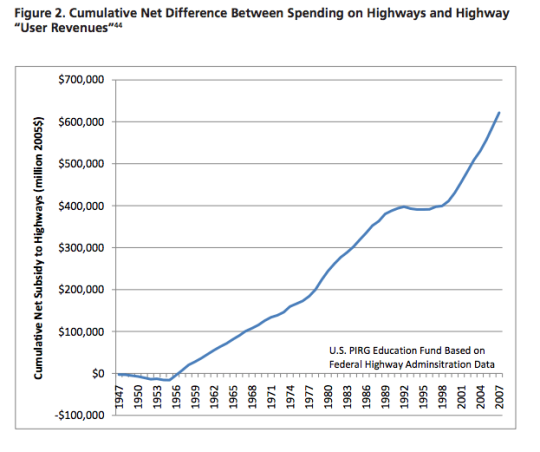
    And the second is this chart, which shows the cumulative net
    subsidy to highways in the US from the late 1940’s:

    image

    The point of all this is that when you subsidize something
    it’s because you’d like to see more, not less of it. So why then are we even surprised by the crippling traffic that plagues our
    cities? We are doing a lot to encourage exactly that.

  • How small is too small?

    I was up early on Sunday morning and I tweeted this out:

    //platform.twitter.com/widgets.js

    It’s a link to a Dwell article about a New York family of four that lives in a 620 square foot apartment. It’s technically a one-bedroom apartment but the way they have it set up is that the two kids share the bedroom and the parents sleep in the living room similar to as if it were a studio apartment.

    And my question in the tweet was, could you do it?

    Part of the reason the article caught my attention was because I currently live in a 640 square foot apartment – but as a family of one. And not surprisingly it’s more than enough space for me. Would I still feel the same way if it were a family of two? I believe so. But what about if it were a family of 3 or 4? I suspect it wouldn’t be as effortless, though certainly not impossible.

    I love the idea of distilling one’s life down to only what is absolutely necessary. And if you happen to live in a city, like New York, where the median price of a one-bedroom apartment is somewhere around $3,400 per month, there can certainly be lifestyle advantages to doing more with less.

    So I’d like to re-ask the question here to the Architect This City community: Could you do it? How minimalist could you go?

  • A Detroit story of single family homes and pianos

    NO MORE MUSIC by Shawn Whitehead on 500px.com

    https://500px.com/embed.js

    I was reading Aaron Renn’s blog this morning and a post called, How Urban Planning Made Motown Records Possible, caught my attention. 

    His argument – taken from a book called Once in a Great City: A Detroit Story – is that the prevalence of pianos in black working class and middle class families was a key ingredient in Detroit ultimately punching above its weight musically.

    Here’s an excerpt that Aaron Renn shared on his blog:

    The family piano’s role in the music that flowed out of the residential streets of Detroit cannot be overstated. The piano, and its availability to children of the black working class and middle class, is essential to understanding what happened in that time and place, and why it happened, not just with Berry Gordy, Jr. but with so many other young black musicians who came of age there from the late forties to the early sixties. What was special then about pianos and Detroit? First, because of the auto plants and related industries, most Detroiters had steady salaries and families enjoyed a measure of disposable income they could use to listen to music in clubs and at home. Second, the economic geography of the city meant that the vast majority of residents lived in single family homes, not high-rise apartments, making it easier to deliver pianos and find room for them. And third, Detroit had the egalitarian advantage of a remarkable piano enterprise, the Grinnell Brothers Music House.

    Detroit is obviously not the only city with lots of single family homes. But it’s fascinating to think that this housing typology, combined with a number of other socioeconomic factors, could be what ultimately led to the creation of the Motown Sound.

    It’s also interesting to think about what kind of talent we might be squandering in our cities. I mean, look what happens when people have access to things like pianos (in the case of Detroit), computers (in the case of people like Bill Gates), and cheap/vacant space (in the case of Berlin and its clubs). They create amazing things.

    This is one of the reasons why I think we sometimes underestimate the importance of small scale moves when it comes to spurring innovation in cities. We forget that people will do incredible things when they are, quite simply, given the freedom to work on projects they are passionate about.

    If we could harness these passions instead of focusing so often on big political announcements, I think we’d all be better off.

  • Make Way for Laneway

    I was speaking with a friend this morning and he told me that he had a Pavlovian association between me and laneways. That made me happy. 

    If you’re a regular reader of this blog, you’ve heard me go on and on about the great potential of laneways and laneway housing (accessory dwelling units) in Toronto, as well as in other cities around the world.

    So I won’t do that today. Instead, I’m going to link to a report that was just released by the Pembina Institute called Make Way for Laneway: Providing more housing options for the Greater Toronto Area.

    The report is obviously about Toronto, but there’s no reason that the lessons and ideas won’t also apply to your city. So I would encourage you to give it a read.

    For those of you who have emailed me about my own laneway house, the project is still on hold. And it will likely remain that way until the city becomes a bit more accepting of this housing typology. Hopefully that will happen soon.

  • The London Crossrail

    On Thursday afternoon the mayor of Toronto, John Tory, was in London meeting with their mayor, Boris Johnston, and talking about Toronto-London business relations, the economy, and transit.

    Here is the tweet:

    //platform.twitter.com/widgets.js

    On the topic of transit, the big item to see and discuss was The Crossrail. For those of you who might not be familiar with it, here are a few bullet points from their website:

    Crossrail is Europe’s largest construction project – work started in May 2009 and there are currently over 10,000 people working across over 40 construction sites.

    The Crossrail route will run over 100km from Reading and Heathrow in the west, through new tunnels under central London to Shenfield and Abbey Wood in the east.

    Crossrail will transform rail transport in London and the south east, increasing central London rail capacity by 10%, supporting regeneration and cutting journey times across the city.

    Crossrail will bring an extra 1.5 million people to within 45 minutes of central London and will link London’s key employment, leisure and business districts – Heathrow, West End, the City, Docklands – enabling further economic development.

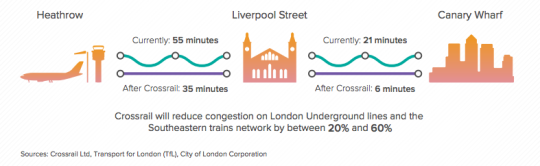
    And below is a neat diagram that I found in this City of London report. I think it does a good job summarizing some of the spatial impacts of The Crossrail.

    image

    In the past I’ve been negative about John Tory’s SmartTrack proposal, which is clearly inspired by The London Crossrail. I had my reasons for that. But I want to be clear that I am not in any way negative on Regional Express Rail as a mobility solution.

    Toronto would benefit greatly from RER and Metrolinx is working diligently to deliver it to the region. I can’t wait for that to happen so I can drive even less than I already do.