Daily insights for city builders, delivered every morning at 6 AM ET. I’m Brandon Donnelly — a Toronto-based real estate developer and founder of Globizen. I’ve been writing here since 2013.

Month: August 2014

  • More thoughts on driverless cars

    image

    If you’re a regular reader of Architect This City, you’ll know that I’m a big supporter of public transit. And that’s because, as far as I can tell, it’s the most efficient way of moving lots of people around a big city.

    But more and more I’ve been thinking about how technology might change, or even disrupt, this school of thought. Which is why when I wrote this post a few days ago, I was careful to say that private cars aren’t the mobility answer. Because in reality, cars likely aren’t going to go away. We’re just going to use them differently.

    Here are the two things I’m thinking about most:

    1. Driverless cars

    I’ve written about driverless cars before in terms of how they might be used as a form of public transit. But I think it’s worth revisiting them for a moment. There are lots of driverless car critics out there and they usually fixate on the fact that a car is still a car, whether or not you happen to be driving it. It still takes up the same amount of space in our cities. Or does it?

    The key thing to keep in mind is that when we’re not longer driving the vehicle, it opens up lots of different possibilities in terms of how they might be used and also how they might be designed. I was watching this fireside chat with the founders of Google the other night and, for them, driverless cars offer the possibility of solving two big problems: traffic and parking.

    We know that parking takes up a lot space in our cities. But that’s really symptomatic of the fact that the utilization rate for most people’s cars is incredibly low. Most of the time a car is sitting parked and idle. But with driverless cars, they’ll be able to drop you off at your destination and then continue on to pick up their next ride–thereby minimizing the need for all that parking.

    This would bring the utilization rate way up for each car, which would also minimize the number of absolute cars that we’d need to have in our cities to move everybody around. Of course, this would mean that we’d be sharing cars. People wouldn’t own cars; they would be an on-demand service.

    2. Networked vehicles

    This brings us to my second point: driverless cars will be networked cars. Again, I’ve written about this before, but I specifically wanted to raise it again because of a new service that Lyft just launched in San Francisco called Lyft Line.

    The way it works is simple. You input where you’re going and Lyft will match you up with others who are going to more or less the same destination. The routes get shared and this brings down the costs to everyday use. It runs on the same principles as the on-demand minibuses I wrote about in Helsinki.

    But if you combine this with driverless cars, you’re starting to get at something incredibly interesting. Now all of sudden you’re getting the door-to-door convenience of private cars with many of the efficiencies of public transit.

    So in my mind, it’s very possible that platforms like Uber, Hailo, and Lyft could became major infrastructure backbones in a world of driverless cars. And if you think about it in this context, then I don’t think the valuations for these companies should seem all that surprising. These are potentially huge innovations.

    In the end, I don’t know how this will all shake out. I don’t think anybody does. I believe that strong public infrastructure (such as subways, light rail, and so on) will still be needed in big cities, but I’m starting to think that mobile apps and driverless cars will also form a big part of how we get around. Probably more so than most people think today.

    Image: Flickr
  • The Globe and Mail: Why Toronto is still a streetcar city

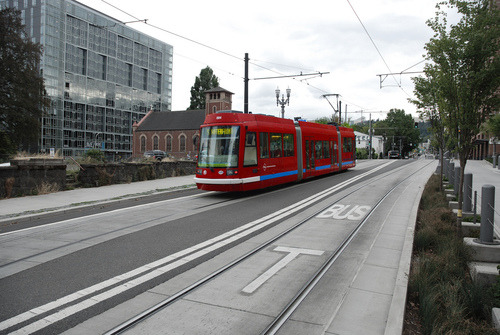
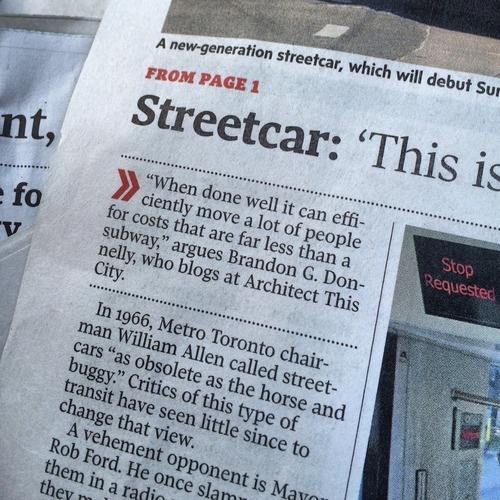
    In anticipation of our new streetcars beginning service this Sunday, the Globe and Mail published an article on Friday called: Why Toronto is still a streetcar city. And I was quoted as saying the following:

    I had no idea that I was going to be cited, but I like the quote that was chosen. The key words are: “when done well.” There are a myriad of different ways in which a city can implement streetcars, and each will have varying degrees of performance.

    So if you’re one of those people who are critical of streetcars, I would encourage you to think about streetcars not just in terms of how they’re implemented today in Toronto, but also in terms of how they could be implemented going forward.

    All streetcars lines are not created equal.

  • Toronto approves 755 storeys of new development

    image

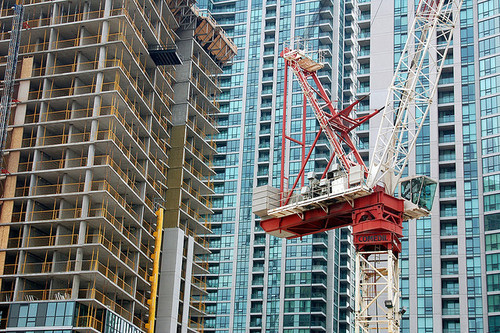
    Earlier this week, Toronto City Council approved the equivalent of 755 storeys of new development, a lot of which will end up in the downtown core. The translates into 6,887 new housing units and roughly 4 million square feet of new commercial space. The Globe and Mail called it the Manhattanization of downtown.

    If you’d like to go through the complete City Council meeting agenda, you can do that here. (I warn you though, it won’t be an exciting read.)

    One notable project that was approved is 50 Bloor Street West, which is a 71-storey mixed-use building in Yorkville adjacent to and on top of Holt Renfrew (It includes a $6 million Section 37 contribution). I mention this one because it’s impressively tall and because it’s a project that I was involved with when I was at Morguard. Watch for Yorkville in the coming years, there’s a lot in the pipeline.

    While I think this is all incredibly exciting, our chief planner, Jennifer Keesmaat, is entirely correct in pointing out that all of this highlights the desperate need for better infrastructure, the most critical of which is a relief subway line that cuts across downtown.

    But to be clear, this isn’t a question of just planning for growth. This is a question of planning for growth and making up for decades of infrastructure disinvestment. That’s the position we’re in today, which means we have a lot of hard work to do. Though I’m confident we’ll get it done.

    The other thing that this level of intensification should highlight for you is that public transit, and other forms of mobility such as biking and car sharing, have to be central to our goals. It’s simply infeasible for everybody to be driving around in a car. We’re currently demonstrating how efficient that ends up being.

    So as Toronto continues to intensify, I think we’ll quickly discover that traffic and private cars aren’t the answer or even the right question to be asking.

    Image: Flickr

  • One year of Architect This City

    Can you believe that it’s already been one full year of Architect This City? Well it has. I wrote this quick post on August 28, 2013 and it kick started a yearlong discipline of writing something everyday (usually) about cities.

    In celebration of this one year anniversary, I thought I would open up the kimono and provide a full look at what one year of regular blogging looks like in terms of the numbers, as well as in terms of the benefits that I feel I derived from it. So here goes.

    Below are my pageviews from Google Analytics (the number at the top of the Y-axis is 10,000). As you can see, it’s been a slow and steady climb:

    image

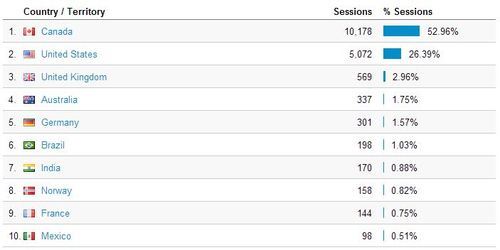
    Here are the top 10 countries that read Architect This City (also from Google Analytics):

    image

    Here are the 5 most read posts from the last year (notice a trend?):

    1. Transitioning from architecture to development
    2. How Toronto became cool
    3. What real estate developers do and why I became one
    4. The future of the architecture profession
    5. A new model for the architecture profession

    And here’s where I sit in terms of followers and subscribers:

    When I started blogging, I already had a few hundred Twitter followers, but probably less than 100 Tumblr followers, and absolutely 0 email subscribers. Interestingly enough, it took almost 11 months to get to 250 Tumblr followers, but only another 3 days to break the 2,000 mark. So these things definitely snowball.

    But the numbers really only tell one side of the story.

    Over the past year I’ve had the privilege of meeting a ton of great people as a result of me putting myself out there publicly. In fact, it has now reached the point where I just can’t keep up with all the requests for coffee. I hate saying no (or forgetting about the email), but there’s only so much time in the day. Regardless though, I’m always flattered and entirely grateful that somebody actually wants to hear what I have to say. So I try and take as many meetings as I can.

    Blogging everyday is certainly a lot of work. But it’s no different than keeping any other routine (like going to the gym) and there are countless benefits to doing so. If you’ve ever thought about starting a blog, I would encourage you to give it a try. Once you get rolling, it actually becomes hard to stop.

  • Personal vs. branded blogging

    As I approach one year of ATC and as people like Lockhart Steele (founder of Curbed and Eater) return to personal blogging, I wanted to share something that’s been on my mind for almost this entire last year. And that is, should ATC just be a personal blog or should there be some greater end goal?

    Right now it’s a bit of a hybrid. It’s hosted at brandondonnelly.com, but along the way I created a somewhat independent Architect This City brand. The most obvious option is to continue to grow ATC and turn it into something like Curbed, This Big City, or Sustainable Cities Collective. In fact, a good friend of mine emailed me a few weeks ago and asked me why I’m not doing that.

    But to do that would require a lot more time and many more posts a day. It would also mean more restrictions on what I can, or should, write about. Personal blogs are, well, personal. Branded blogs typically require a focus. Today I live comfortably in between both of those worlds. I write almost exclusively about city building, but I introduce many personal touches. Architect This City has become my personal brand.

    In many ways, I feel like this tension is a natural one. With the rise of social media and the belief that “everybody is their own media company”, more and more people are finding themselves debating whether or not they should position themselves personally online or create an independent brand.

    At the same time, blogging is evolutionary. It’s a laboratory. And most of the benefits are entirely indirect. Writing helps you get your ideas on “paper” and sort through them publicly. And sometimes that leads to unexpected outcomes. I mean, in the case of Lockhart, he started blogging about his Lower East Side neighborhood and that gave birth to Curbed, which he then sold to Vox Media.

    So as much as I try and plan out where I think blogging everyday could take me, it’s also good to sit back, enjoy the ride, and just see where it takes me.

  • How much should a ride on the Union Pearson Express cost?

    When I was in Chicago a few weekends ago, one of the things we did was take the train from Midway Airport to downtown. We were a large group, but since it was only $2.25 and we figured it would be easier and faster than contending with traffic, we decided to take it.

    Since it was their local transit service (as opposed to a dedicated airport rail line), the train came within a few minutes and it took us about 25 minutes to get to the Loop. It was a great experience. And I would take it again the next time I go to Chicago.

    I mention this because there’s been a lot of debate in Toronto recently about the potential ticket price for the new Union Pearson Express train to the airport. Some are suggesting that it could cost upwards of $30 for a one way ride, which would also take 25 minutes and would leave every 15 minutes.

    The concern is that at this price, the train will only serve the business community and the rich. And indeed, it’s a lot more than the $2.25 I paid when I landed in Chicago earlier this month. But at the same time the Union Pearson Express promises to offer a more refined travel experience than your regular old subway train. So how should it be priced?

    Pricing exercises are really interesting because, as David Fitzpatrick pointed out in a recent tweet, increasing the price of the ticket will lower ridership. And at a certain point, this will cause overall revenues to also decline (the loss in ridership stops being made up by the higher ticket price). So, in theory at least, there exists a magic, profit maximizing number.  

    Of course, profit may not be the only goal. One might also be interested in reducing the number of vehicles on the road, promoting sustainability, and generally providing people with a convenient way to get to and from the city’s biggest airport. And should this be case, then those factors also need to be worked into the pricing model.

    Now, I don’t know what that magic number should be off hand, but I do think we need to be clear on our goals as that decision is made.

    I personally believe that we underprice roads in this city, which is why we have such a supply and demand imbalance (i.e. gridlock). And so if we decide that rail travel should be a premium service, then I don’t think it’ll do much to correct that imbalance.

  • Streetcars are just a tool

    Earlier this month the Toronto Star published an article talking about the resurgence of streetcars in American cities. According to the Star, 89 cities in the US are currently implementing or at least considering building some form of surface-rail system.

    But the article also goes on to argue that it could be a snobbish fad. Streetcars are new. They’re shiny. And they make yuppies –  who don’t like taking buses – feel better about themselves. But is the ROI really there? Is the economic impact of streetcars as big as people are making it out to be?

    To support this argument, the Star quoted transportation planner Jarrett Walker, who I’ve mentioned here before on Architect This City. But according to a follow-up post that Walker did on his blog, it would appear that he was misrepresented in the article. Here’s a snippet of his response:

    Here’s the bottom line. Streetcars are just a tool. They can be used in smart ways and in stupid ways. Asking a transit planner for an opinion about a transit technology is like asking a carpenter what his favorite tool is. A good carpenter sees his tools as tools and choses the right one for the task at hand. He doesn’t use his screwdriver to pound nails just because he is a “screwdriver advocate” or “hammer opponent”. Yet the Toronto Star assumes that nobody involved in transit debates is as smart as your average competent carpenter.

    I wanted to share this because I think it’s a great way to approach transportation planning and because I think it gets at a larger issue that we continue to face here in Toronto: We keep politicizing mobility tools. Cyclists have become pinkos. Streetcars are a war on the car. And the list goes on. How about we just look at the problem, and figure out what solution would work best?

    Image: Flickr

  • How you can be more lucky

    I don’t have any tattoos and I have no plans of ever getting one, but if I were in the market for something to tattoo on my body, this Latin phrase would be a solid contender: Audentes fortuna iuvatIt translates into something along the lines of: Fortune favors the bold. And it’s one of my favorite proverbs.

    The supposed meaning behind the phrase is that Fortuna, the Goddess of fortune and luck, was believed to be more likely to help those that took risks, took action, and were generally bold. And what I like about this is that it doesn’t make luck some abstract thing that people either have or don’t. It firmly transforms luck into something that you yourself can create. That is, if you want it.

    Earlier this month, venture capitalist Fred Wilson wrote a post on his blog called Get Lucky, where he talks about the research that psychologist Richard Wiseman did on so-called lucky and unlucky people. Wiseman concluded the following:

    My research revealed that lucky people generate good fortune via four basic principles. They are skilled at creating and noticing chance opportunities, make lucky decisions by listening to their intuition, create self-fulfilling prophesies via positive expectations, and adopt a resilient attitude that transforms bad luck into good.

    Obviously, the common thread between these two ideas is that luck is something that you yourself can control. Lucky is a state of mind. Whether you believe in greater powers or not, people at least as far back as the Roman times identified the benefits of taking action, risk, and of boldness. It creates opportunity. And it creates luck. 

    I try and do as much of that as I can.

  • What should San Francisco do with the Tenderloin?

    image

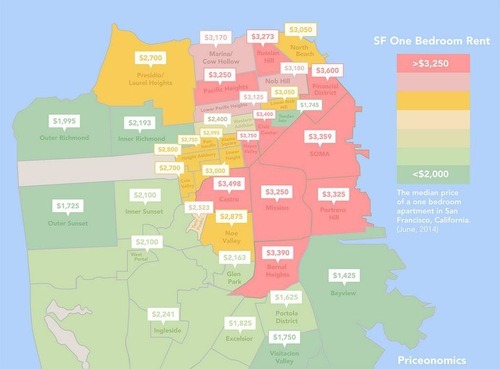
    Recently Priceonomics posted a piece on San Francisco’s “rent explosion.” In it, was the infographic above showing the median rental rate for a 1 bedroom apartment in the city. The most obvious takeaway is that San Francisco is real expensive. In the core of the city, you’re easily looking at $3,000 per month.

    That is with one exception: the Tenderloin (the green area just northwest of SOMA in downtown). The first time I ever visited San Francisco, I actually stayed on the outskirts of this area, which is a neighborhood well known for seediness, homelessness, crime, drug trade, strip clubs, and so on. And it was actually named after a similar neighborhood in New York that was also a center of vice in the late 19th and early 20th centuries.

    But when I saw this diagram, I immediately asked myself: How could it be that the Tenderloin was holding out so well against the forces of gentrification? How is this island of seediness being preserved in the center of downtown? Particularly in a city like San Francisco where there’s a perpetual housing supply shortage and lots of wealth. The Tenderloin has some of the lowest rents in the city.

    So I tweeted the good folks at Priceonomics and they responded with this article. It’s a few pages long, but the reasoning seems to come down to the following: active community groups that fought to keep developers out of the area (and that also own many of the buildings), downzoning, and a high percentage of rooming houses. According to that same article, the Tenderloin contains approximately 100 single room occupancy residential hotels (or SRO’s as they’re called). These were initially built to house the city’s transient and seasonal population after the great fire of 1906.

    So it would appear that there are some significant barriers to entry.

    But at the same time, it generally seems like a bad idea to concentrate poverty, homelessness, drug users, and so on. Interestingly enough, the article talks about how when the Bay Area’s transit system went on strike for a period of time, the supply of drugs actually dried up in the Tenderloin. This underscores how regional the drug business is, but also makes me think that dealers are almost surely benefiting from the clustering of their client base.

    In any event, this is a much larger problem than just a real estate development one. I don’t know what the solution should be, but I’m pretty sure that things are being made worse by concentrating everything in one neighborhood and by rising income inequality in the city. Inequality seems to lead to all kinds of negative externalities and, from my experience, mixed-income neighborhoods perform better than 100% poor ones.

  • A new vision of Yonge Street

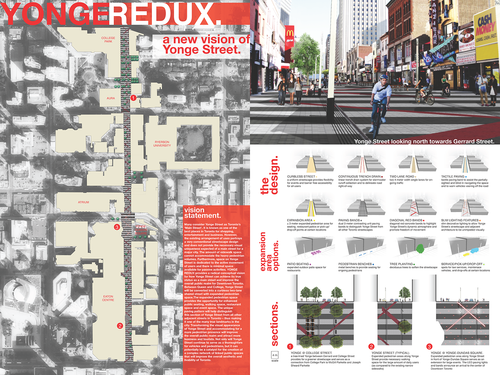
    Back in April I wrote about a competition for young people to reimagine public space in Toronto. It was called NXT City. Well that prize has been awarded and the winner was Richard Valenzona for his vision–called Yonge-Redux–of a new and reimagined Yonge Street. To download the PDF of his entry (the image shown above), click here.

    The proposal encompasses a stretch of Yonge Street that runs from Queen Street in the south, to College Street in the north. It would capture the Toronto Eaton Centre (mall), Yonge-Dundas Square, Ryerson University’s expanded Yonge Street footprint, and the massive mixed-use developments happening in the College Park area (see Aura Tower). To quickly simplify, the proposal is essentially about enhancing the urban experience, prioritizing pedestrians, and reducing the flow of cars to two lanes.

    Overall, I think it’s a wonderful proposal and I’m not surprised it won NXT City. This type of intervention is on so many of our minds. In fact, it’s somewhat surprising that we’ve been as slow as we have to improve our main street. There are so many anchor institutions, such as the Eaton Centre and Ryerson University, that plug into this section of Yonge Street. It makes a lot of sense.

    But as I said in my original post, one of the most exciting things about the NXT City Prize is that it has always been about execution. This is not just an academic exercise–or at least that’s the hope. This exercise is about spurring real change in the city and I genuinely hope that they’re successful in doing so. Because then I can turn around and say: Take that Melbourne 🙂

    Kudos to Richard Valenzona, Mackenzie Keast, as well as everyone else involved in NXT City, for making this initiative a reality and for doing your part to make Toronto even more awesome.