Daily insights for city builders, delivered every morning at 6 AM ET. I’m Brandon Donnelly — a Toronto-based real estate developer and founder of Globizen. I’ve been writing here since 2013.

Month: June 2014

  • Your thoughts on the real estate marketplace, please

    If you know me at all, then you’ll know that I’m a big proponent of introducing more technology into the real estate space. I think the industry is one that has been incredibly slow to embrace technology, but that it’s only a matter of time before it does.

    Two months ago I wrote a post talking about how entrepreneur and venture capitalist Keith Rabois is working on a home buying startup codenamed Homerun — now called Opendoor. Here’s how he recently described the state of affairs:

    “My friend [PayPal and Palantir cofounder] Peter Thiel suggested that I come up with an idea to innovate in residential real estate,” Rabois told VentureBeat in April. “It’s the largest part of the economy unaffected by the Internet. And that was definitely true then, and even with things like Trulia and Zillow, it’s fundamentally true today. But the process of [selling a home] hasn’t been transformed by technology.”

    What Opendoor is trying to do is really interesting, but I have a different idea. It’s called Unlyst. And today I’d like to ask the ATC community for a small favor. I’ve created a short home buying and selling survey (embedded below) that will take you at most 2 minutes to complete.

    If you could please take the time to do that, I would greatly appreciate it. I’ve made the results public as well, so you’ll be able to see how buyers and sellers currently feel about the real estate marketplace. If you can’t see the survey below, please click here. Thanks for your help!

    [googleapps domain=”docs” dir=”forms/d/1bKvHYdSUfYH3AGX7LcLIK0_-i7nt7WIdTmHeaJ8P7pY/viewform” query=”embedded=true” width=”760″ height=”500″ /]
  • Cawthra Park revitalization

    I must have been living under a rock because I just discovered this weekend that Toronto is in the midst of hosting WorldPride. I obviously knew that it was Pride Week, but I didn’t realize that we had outbid Stockholm in 2009 in order to be awarded the event. 

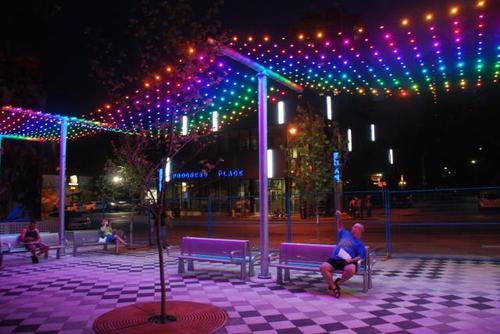
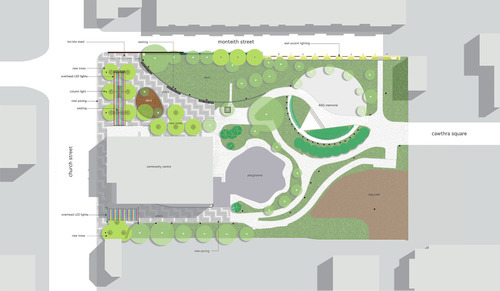
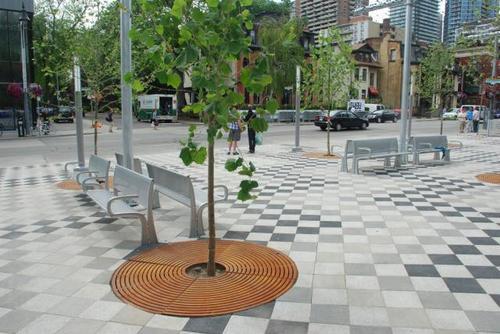
    I also didn’t realize that Cawthra Park near Church Street & Wellesley Street was being revitalized in preparation for both WorldPride 2014 and for the Pan Am & Parapan American Games in 2015 – which Toronto will also be hosting.

    Here’s a site plan of the final design:

    image

    And here’s what the completed design looks like:

    image

    image

    I like the pavers and I like the overhead LED lights. Those may not seem like big additions, but it’s amazing how those small little details can impact the way a space feels. I think it creates an intimate and inviting space. What do you think?

    Images: thinc design

  • Revisiting the urban farm

    If you’re a regular reader of ATC, you might remember that last month the team at TAS planted 100 EarthBoxes on the roof of our office building to grow everything from beets to hot peppers. Well it has now been over a month, so I thought it would be interesting to show you the progress that has been made.

    May 16, 2014

    June 27, 2014

    The area we’re occupying on the roof is probably around 400 square feet and many of the EarthBoxes have already been harvested a few times. So it just goes to show you how little you need to grow quite a bit of food. Now imagine what we could do if we transformed all of our urban rooftops.

  • Without trust, you have nothing

    I was reading Fred Wilson’s AVC.com blog this morning (as I do every morning), and I thought his post on trust was a really important one. He was talking about it in the context of building successful web applications, but I don’t think it’s only applicable to internet businesses.

    As marketer Seth Godin wrote on his blog earlier this year, the most important questions are not:

    Is my price low enough?

    Is it reliable enough?

    Do I offer enough features?

    Am I on the right social media channels?

    Is the website cool enough?

    Am I promising enough?

    No, the most important question in marketing something to someone who hasn’t purchased it before is,

    “Do they trust me enough to believe my promises?”

    Without that, you have nothing.

    I thought this was such an awesome, yet simple, post that I actually circulated it to a bunch of people in the office after I read it. Because whether you’re marketing widgets, marketing private cloud storage, marketing to investors, or marketing new condominiums, that question of trust is paramount.

    And it’s for that reason that I think social media and mediums such as blogging have become so important. Customers want to feel like they trust you before they buy your product. The best brands know this and forge “relationships” with their customers. And with the tools at our disposal today, it’s become a lot easier for companies to do that.

  • Do you love or hate streetcars?

    image

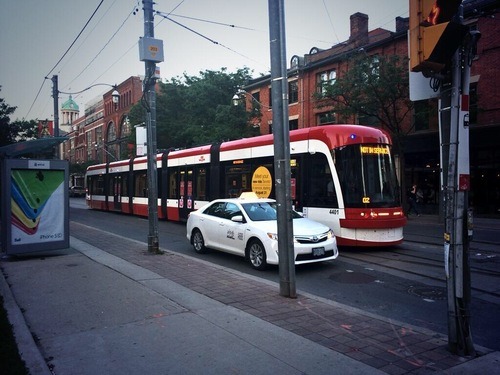
    Tonight I saw one of Toronto’s new streetcars cruising down King Street. They’re still in test mode and the first batch won’t go into operation until this August, but every now and then you’ll see one circulating around the city. This was the first one I’d seen in person.

    If you’re a transit geek or urbanist, you’re probably excited about the arrival of these new streetcars. But I know that there are a lot of people who aren’t. They hate streetcars and they think of them as basically rolling stop signs on our congested downtown streets. And since these new streetcars are even longer than our existing ones, they’re worried they’ll just make the situation worse.

    Personally, I think that streetcars mixed into traffic is generally pretty inefficient. But I know that surface light rail has the potential, when executed properly, to be a cost-effective and sustainable way of efficiently moving lots of people around a city. When I lived in Dublin I took the Luas every day. It was great.

    So I’m curious to hear from you. What do you think of Toronto’s new streetcars? Let me know in the comment section below.

  • Tech and the City

    image

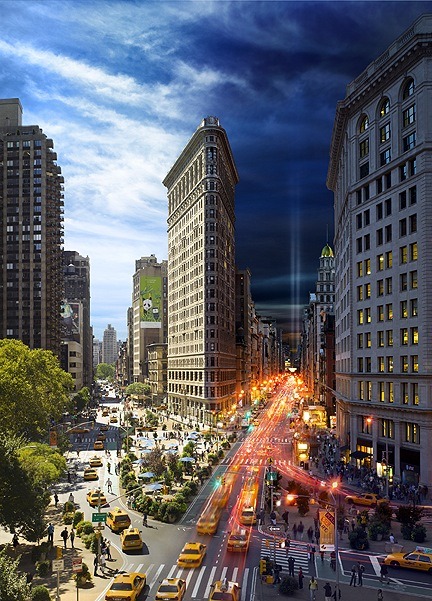
    I’m reading a great book right now called Tech and the City. I’m only 31% of the way through it (according to my Kindle app), but already it’s been an interesting read. It’s about the making and rise of New York City as a technology and startup hub – which, is fairly recent phenomenon. There aren’t too many cases where New York plays second or third city, but tech is one of those instances. Silicon Valley dominates.

    The book talks about the deliberate efforts that were made, by the Bloomberg administration as well by many others, to diversify New York’s economy away from financial services and towards technology, startups, and entrepreneurship. It gives you all the backstory about the rise of Silicon Alley in the 90s, its subsequent crash in the dot com era, and all the players involved. And yes the reference to Sex and the City is both on purpose and explicit throughout the book.

    But at a time where cities all around the world are trying to replicate the success of Silicon Valley, the takeaways from this book are perhaps universally applicable. It certainly got me wondering if, here in Toronto, we’re doing enough to prepare our city to dominate in the 21st century.

    Image: Stephen Wilkes

  • Introducing Polyform Labs

    image

    A few weeks ago I had coffee with a friend of mine who is a partner at a Toronto-based enterprise software company called Polyform Labs. Their products are geared towards the commercial real estate industry and, since I’m a big proponent of introducing more technology into the real estate space, I thought I would share a little bit about them with you all today.

    The first of their 4 main products is called Lingo, which is a machine learning tool that helps companies quickly review legal documents and contracts. In the case of commercial real estate firms, the most obvious use case is leases. These documents are often hundreds of pages long and, if you have a big portfolio of properties, I’m sure you can imagine how quickly these pages add up.

    What’s neat about Lingo is that you basically upload a lease and then the tool interprets and summarizes all of the clauses for you. It then tells you where you’re potentially exposed and where your risk factors are. And if by chance it gets it wrong, you can correct it and the system will actually get smarter – hence the machine learning part.

    I’m not going to go through their entire product line, but I did also want to mention one more called Aura. They call it a “location-aware loyalty engine”. And you may have heard of similar products out there in the marketplace. What it does is use the MAC address on mobile phones (which is a unique, but anonymous, identifier) to track how people and crowds move through spaces.

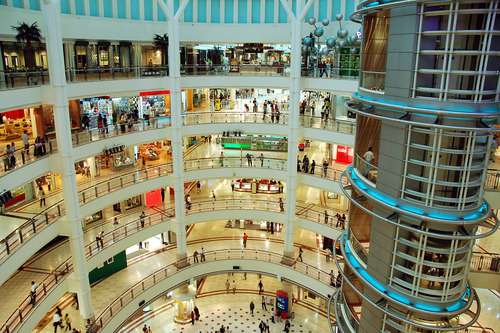
    The most common use case I’ve come across is within shopping malls and retail spaces. It’s used to determine which stores have the most foot traffic, which departments and aisles draw the most people, how long people stay in each store, where they buy, and so on. So even if you didn’t already know about this technology, you may have already been giving up your location data. There are lots of mall landlords using it.

    And it’s producing some interesting data. For example, as soon as somebody buys one thing in a mall, their propensity to buy something else grows exponentially. This is what the data tells us and I can certainly relate to it from my own experience. So as a mall landlord and tenant, you are obviously trying to figure out ways to encourage people to make that first purchase. 

    The other use case that (obviously) came to my mind was with respect to city planning and urban design. How could we harvest anonymous location data to improve the way we design both our private and public spaces? Imagine if we had this data for subway stations, public parks, public plazas, and so on. I bet we would discover all kinds of ways to improve the experience within our cities. I’d like to see the location data for Trinity Bellwoods Park in Toronto on a sunny summer day.

    But I digress.

    If you’d like learn to more about Polyform Labs and their real estate products, click here

    Image: WPC

  • Why Vancouver’s housing market hinges on China’s economy

    Last week a friend of mine sent me a really fascinating article from The Economist talking about the role of foreign investors in Vancouver’s housing market. If you subscribe to The Economist, you can click here to read the article. If you don’t subscribe, you’ll have to rely solely on what I’m about to say.

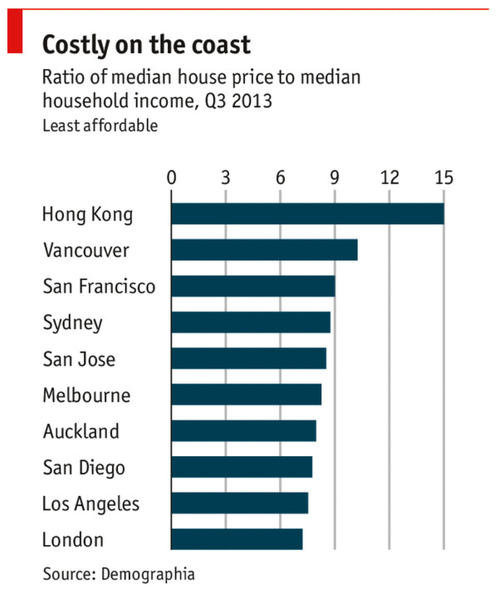
    In case you weren’t aware, Vancouver is an incredibly expensive city when it comes to real estate. The average price for a single-family detached house is now around C$1 million. By some measures, that makes it the most expensive housing market in North America. Here’s a chart that looks at house prices as they relate to household income:

    image

    According to The Economist, the median household income in Vancouver is $68,970. This places them 23rd out of 28 in terms of Canada’s major cities. So how is it that homes are, on average, selling for $1 million? The locals don’t seem to be able to afford them.

    Well, it’s a well known fact that Chinese buyers continue to be an integral part of Vancouver’s housing market. In fact, up until this year, Canada offered a fast track option for citizenship applications if you brought at least $800,000 into the country.

    So we know that foreign buyers are having an impact. It’s a phenomenon we’re seeing in many other cities around the world, such as London. But to what extent is hard to measure–which has forced analysts to get creative.

    To try and figure out what percentage of homes are going to foreign buyers, analysts have been looking at macro data, filing through sales records, and even monitoring utility bills to see which homes might be sitting empty.

    What they found is that there’s a fairly significant correlation between economic activity in China, and Vancouver’s housing market. When the Chinese economy does well, so do Vancouver homes. Interesting. Still, that doesn’t quantify impact.

    When analysts looked for utility bills that would suggest an empty home, they found that only about 8% of high end downtown condos were likely sitting empty. That’s a relatively small amount. It could be vacancy rate.

    But when they looked for “mainland Chinese-sounding names” on sales records, they found that for homes priced $3M and up, almost ¾ of the buyers could be from mainland China. Now that’s a significant number!

    I found this all rather fascinating and I thought you all might as well. It yet again reminds me of how much opacity there is in real estate markets. We’re all craving better data. Why else would people be scouring utility bills?

  • The birth of tall buildings

    As an architecture and city lover, it’ll probably surprise you that I’ve never been to Chicago. I think it may have to do with the fact that it has always felt like a sister to Toronto–another Great Lakes city of comparable size. And when you travel, you often want something novel.

    But that’s no excuse. 

    Thankfully I’m happy to report that last week I booked a trip to Chicago for this August. I’ll be there for an extended long weekend. But since it’s for a bachelor party, it remains to be seen how much archi-touring I’ll actually get a chance to do.

    Chicago is a hugely important city in the world of architecture and city building. From Frank Lloyd Wright to Mies van der Rohe to Louis Sullivan, the city has deep architectural roots.

    When most people think of skyscrapers they think of New York. But in actuality, if there’s one city that gave birth to the modern skyscraper I would argue that it was Chicago. And it was made possible by the steel industry.

    Before the late 19th century, tall buildings were largely built with their exterior walls supporting most of the loads. This meant that the taller you went, the thicker the walls had to be near the bottom of the building. This is why older buildings often feel so heavy and permanent.

    But when structural steel became widely available, a new building form was created. All of a sudden architects and builders could create relatively light weight structural steel frames to support the building. The skin, or outside of the building, was no longer carrying the weight.

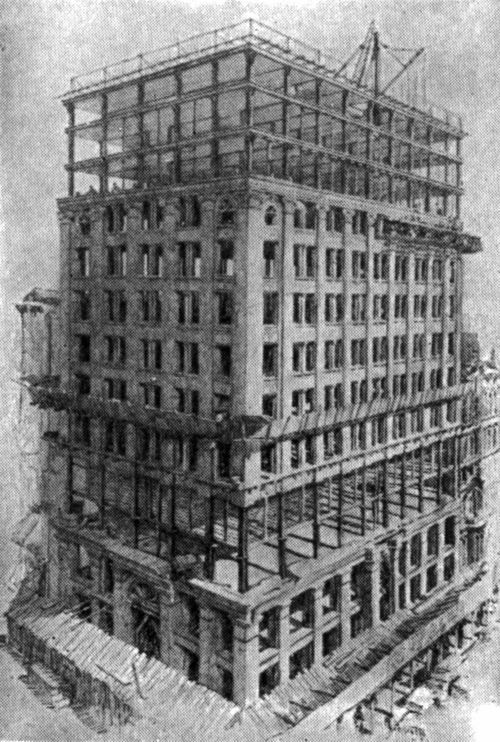
    That made images like this possible:

    image

    For most of us today, this building under construction looks fairly typical. First the structure goes up and then it gets clad with its window and exterior skin. But at the time, this sort of construction technique–with the 3rd and 4th floors still unenclosed and the upper floors finished–would have blown people’s minds. It was an entirely new way of building.

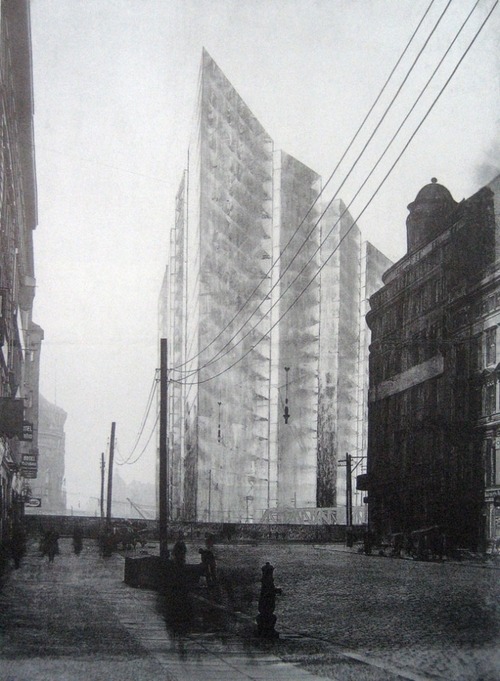
    Steel framed buildings removed the technical limitations of building tall and also opened up entirely new possibilities for architectural expression–such as the all glass building. Today, there’s a lot of criticism around our glass buildings. But it’s interesting to note that it started as the futuristic dream of architects.

    image

    Freed from the technical limitations of load-bearing exterior walls, architects such as Mies van der Rohe began dreaming of transparent, all glass buildings. For them it represented modernity. It was the future. Above is an early charcoal sketch of that dream by Mies.

    But our fixation with glass and transparency has never been because of environmental efficiency. It was about light, transparency and feelings of modernity. So as sustainability becomes increasingly critical, we should remember that there’s still lots of innovating left for us to do.

    Art and architecture has always been a representation of the time and era in which it was created–which is one of the reasons I’m so interested in technology today. It’s our era. It’s our “structural steel”. And it’s going to impact our cities.

    When posterity looks back on us and what we’ve done, I’m sure that will be clear.

  • Stuck in condoland?

    Toronto Life recently published an interesting article called Stuck in Condoland. A lot of people have mentioned it to me, so there seems to be a lot of interest in the topic. It basically profiles the lives of a few young families who live downtown and are trying to raise young children in relatively small condos (think 700 square feet).

    I thought it was interesting because I like the idea of small and efficient living. The average post-war bungalow in Toronto was probably less than 1,000 square feet. And so this modern notion that you need a big house in order to properly raise a family is a relatively recent phenomenon. Although we’re a richer city today and that’s what happens when people become wealthier: they consume more.

    But the article also makes it seem that developers only want to build small condos and that larger condos and single-family homes just aren’t profitable enough. Thus the reason all these families are being forced to into tiny shoeboxes in the sky. But that’s not really true.

    Look, just like every other for-profit business on the planet, developers are concerned with making money. And so they will always look for ways to increase efficiency, drive down costs, and so on. But there are certain realities of the market that developers don’t have control over.

    First, developers aren’t building new single family homes in the city (at any sort of meaningful scale) because there’s no land to do so. And because the land use policies in place and the current thinking around how we can more sustainably build our cities for the future dictate that we should be building more intensely. In other words, building up. So it’s not a question of developers not wanting to build single family homes; it’s a question of not being able to.

    Second, trust me when I say that if the market wanted large 3 bedroom family units, developers would build them. Mandating them is a useless exercise if people don’t want them or are unable to afford them.

    The challenge we face is that a reinforced concrete condo tower is more expensive to build than a wood-framed single family house. So until land values get to a point where single family homes become the more expensive option (compared to condos), I don’t think we’ll see a huge rush towards 3+ bedroom suites.

    This is my hypothesis at least. Because when you buy house, you’re really buying two things: the house itself and the land. If the house itself (wood) is cheaper to build on a per square foot basis than a condo (concrete), then the variable that will make a difference is the land. And as people like to say: “buy land, they ain’t making any more of it.”

    So what I’m saying is that I just don’t think the situation is as simple as: “developers are bad, all they want to do is build tiny condos and make lots of money.” It’s more complicated than that. But I do believe the question of how families are going to live in the city is an important one.