Daily insights for city builders, delivered every morning at 6 AM ET. I’m Brandon Donnelly — a Toronto-based real estate developer and founder of Globizen. I’ve been writing here since 2013.

Month: February 2014

  • Debating Porter’s plans

    Before going snowboarding this morning, I got into a bit of a heated debate on Twitter about Porter Airlines’ plans to expand the Toronto Island Airport and fly the new Bombardier CS100 from it. The proposal is facing a lot of opposition and, since I’m generally for it, the conversation got a bit lively.

    At one point, I called somebody a NIMBY, which was probably an unproductive thing to do. But I was trying to better understand that person’s position. The argument was that parks (ie. the Toronto Islands) and planes don’t mix and so the proposal is bad. However, since we already have planes operating out of the island today, I wanted to know if what we have today was considered acceptable and, if yes, what the precise concerns are regarding the expansion.

    In other words, I was trying to get a better sense of the threshold in which people start to feel the airport is a detriment to Toronto’s waterfront. Is it already considered a hindrance to waterfront enjoyment (it certainly isn’t for me) or is it a question of increased noise and flight volume bringing it over the edge?

    Today the airport moves over 2 million people a year. So I have a hard time buying the argument that this is only a boutique airport for the elite. Clearly, it’s filling a need in the marketplace. And so I think it would behoove us to figure out how to balance the economic gain with the concerns of urban livability. I hope that we’ll be able to do that.

    What’s your position on Porter’s plans? I would love to hear from you in the comment section below.

  • Alleys and laneways

    In addition to having an incredible mountain just 12 miles away, the town of Jackson is also a really cool place in its own right. It’s a cowboy town with endless wilderness all around it. But since it’s such a big tourist destination, the town is filled with great restaurants, art galleries, and the obligatory real estate brokerages trying to sell vacation properties.

    Here’s what the town looks like from the top of Snow King (the in-town ski mountain). Photo credit: David Stubbs for the New York Times.

    But from a land use standpoint, I also find the town really interesting because of its network of fine grain alleys. Here’s a picture of Gaslight Alley. For those of you who are regular readers of this blog, you’re probably aware that I’m a big supporter of laneway housing in Toronto. I think it’s a hidden opportunity. It could be another—more intimate—layer to the city.

    Today, building a laneway house is virtually a non-starter with the City of Toronto. Whether it’s issues of utilities or the fact that laneways don’t easily accommodate service vehicles (maybe we need smaller service vehicles), the city has a litany of reasons for why they just won’t work.

    But I’m absolutely certain that we could figure out solutions to all of the obstacles if we really put our minds to it. It’s not a question of not being able to do it, it’s a question of not wanting to do it.

  • The powder clause

    Jackson Hole has been on the top of my list of places to visit for a number of years now. And having just snowboarded it for the first time, I can honestly say that it lives up to the hype. It’s by far the most aggressive mountain I’ve ever had the pleasure of riding on. We also got lucky with 9” of fresh powder.

    But in addition to some great riding, I also learned of something new today: the “powder clause”. And from what we’ve heard from the locals, lots of employers in the region offer it. What it means is that if there’s a fresh dumping of snow, you’re allowed to take the morning off work so that you can go ski “the pow.” I think this is brilliant.

    If you’re from a big city (or you don’t ski), this may seem a bit absurd. But I think the “powder clause” underscores a growing trend happening in a lot of cities around the world. We’re seeing the rise of the consumer city. Historically, cities were all about agglomeration economies. But today, amenities matter. People choose first where they want to live and then look for a job (or start their own company).

    Some places are blessed with natural amenities. But for the rest of us, we have to work at creating our own. That’s where city building comes into play.

  • White peaks

    I like airports. And this past weekend was my first time in Denver’s. Its most obvious feature is its white fabric roof, which is intended to evoke the snow-capped mountains that surround the region (as well as teepees apparently).

    Here’s what it looks like from the inside:

    And here’s what it looks like from the outside (via Wikipedia):

    What I like about it is that it speaks to the place. In our increasingly global world, more and more of our buildings now look the same. This is what Modernist architects wanted, but I’d argue that that was a different time and place.

    Today, there’s something nice about landing in a new city and feeling like you’re somewhere different. There’s something special about architecture that speaks to its environment.

    Is there an airport that stands out for you?

  • To drive or not to drive

    I’m writing this post from some lounge called Apropos at Toronto’s Pearson Airport. I’m waiting to board my flight to Denver and kick-off the 5th Penn Annual. Technically, the Annual is being held in Jackson Hole this year, but 2 of us are jamming in a few extra days in Vail beforehand. I like to make the most of these trips.

    As I was arriving at the airport, I made sure to check up on the status of the new Union Pearson (UP) Express station that’s currently under construction and slated to open in spring 2015. Once the line is complete, Union Station and Pearson Airport (Canada’s two busiest transportation hubs) will be connected by a 25 minute express train operating every 15 minutes. I’m pretty excited about this.

    One of reasons I’m excited is because I think that really great cities should be easily navigable without a car. I’m not saying that cars shouldn’t be allowed or that we should make life purposely difficult for drivers; I’m saying that the decision of whether or not to use a car should be entirely personal. Some parts of Toronto meet this criteria, but other parts most certainly do not.

    One of the parts that doesn’t is the trip to Pearson. Today, getting from downtown to Pearson on public transit is a terrible experience. I don’t recommend it. And so you’re basically forced to drive, get a ride or take a taxi. That’s fine, but it’s not ideal—particularly for non-residents.

    I like to think of visitors to a city as customers of that city. From the moment they land in the airport, they’re now using your product or service. And for most people, the first thing they’re thinking about is how they’re going to get to where they need to go. How are you going to help them?

    If you can put them onto an express train, and quickly and comfortably bring them into the city, then you’re already impressing them. Unfortunately though, we often don’t think of visitors in this way—unless you’re hosting some major event like, say, the Pan American Games. Then you really start to think about customer experience.

    Either way, the Toronto experience is about to get a whole lot better next year. And I’m excited about that.

  • Development Profile: The Well

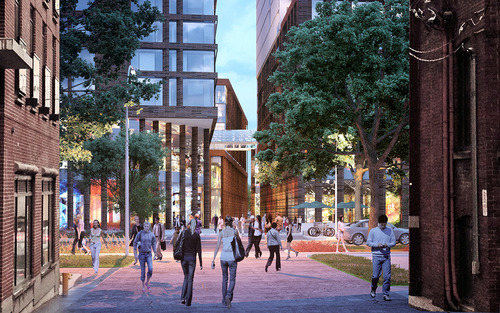
    The Globe and Mail lands in Toronto, located between Front Street and Wellington Street, west of Spadina Avenue, have been in play for quite some time. But since the Globe and Mail confirmed last year that it would be moving its headquarters to a new First Gulf office building on King Street East, the lands opened up as a prime redevelopment opportunity.

    Earlier this week I discovered the plans. It’s a new mixed-use neighborhood called The Well. And it’s a partnership between Allied Properties REIT, RioCan and Diamond Corp, with the master plan design being prepared by Hariri Pontarini Architects.

    Here are a few photos.

    Wellington Street looking east:

    image

    Wellington Street looking west:

    image

    Laneway looking south into the development site:

    image

    And here are some high level stats:

    • 7.7 acre site (Globe and Mail lands)
    • Encompasses Draper Street, which is a heritage designated street
    • Approximately 500,000 square feet of retail space
    • More than 1,000,000 square feet of commercial office space
    • More than 1,000,000 square feet of residential space

    From the early renderings, the project looks incredibly promising. Wellington Street East is a great street, but the south side of it is currently a mess. With a new lining of well designed midrise buildings on it, the street could be spectacular.

    I like that there seems to be a focus on creating a fine grain network of streets and laneways. And it’s making me think that this stretch of Wellington could work really well as pedestrian only. Both ends of the street terminate in a park (Victoria Park on the west and Clarence Square on the east), which would make it a really beautiful (dumbbell shaped) urban space.

    This is something Toronto doesn’t have today. This could be our opportunity.