Daily insights for city builders, delivered every morning at 6 AM ET. I’m Brandon Donnelly — a Toronto-based real estate developer and founder of Globizen. I’ve been writing here since 2013.

Month: December 2013

  • Why New Year’s resolutions suck

    It’s nearly 2014. And I suspect many of you are about to begin pursuing your New Year’s resolutions (or are at least contemplating the idea). Unfortunately, I’m here to deliver some bad news: they don’t work. Statistically, the odds are against you. In fact, a 2007 survey done in the UK found that 88% of all resolutions end in failure!

    So why do we keep making them? Well, old habits die hard.

    But to be perfectly honest with you, I’ve never been a fan of New Year’s resolutions. They strike me as silly. If I smoked (which I don’t), why would I wait until the New Year to “quit”? Because I don’t really want to quit and this prolongs it. It’s a form of procrastination.

    If you really want to do something, do it right now—whether it’s May or October. It’s that simple. And if you’re not willing to do it right now, then, to be honest, you probably don’t want it that bad. And if you wait until the New Year, you’ll almost certainly fail.

    But I will say that I do enjoy and believe in goal setting. I keep lots of lists (using apps like Clear and Evernote). In particular, I like to actively manage two sets of goals. I call them “My Progressive Goals” and “My Disciplines.”

    Progressive goals are things, like the name suggests, that grow and evolve over time. For example, completing my MBA, ahead of schedule, was one of my progressive goals for 2013. Check.

    My Disciplines, on the other hand, are activities that in and of themselves don’t change. They’re just things I’ve committed to doing and I use the list as both a reminder and as a way of ensuring I don’t take on too much (which I have a tendency of doing).

    These are things like blogging here everyday, going to the gym regularly, and doing one big snowboard trip with the guys from Penn every year. I’ll still set progressive goals within each discipline, but the disciplines themselves stay the same. They are, after all, disciplines.

    So as much as I scoff at New Year’s resolutions, I have been tuning up my goals and disciplines for 2014. Blogging became a big part of my life in 2013 and I look forward to getting better at it in the New Year. Thanks for reading Architect This City. Don’t forget to subscribe to my newsletter.

    Onwards my friends!
  • Toronto’s concession roads

    I’m late in writing this blog post because I was up in Collingwood for the day snowboarding. I’m exhausted, but I do have something to say.

    One of the things I always find interesting when I’m driving north of the city is how far Toronto’s major north-south streets extend. Go out to Aurora or Newmarket and you’ll still come across many familiar faces such as Jane, Keele, Dufferin, Bathurst and Yonge Street. And the distance between each of them is exactly the same as it is in the city: 2 kilometres.

    This may not seem like much of a big deal, but have you ever wondered how this street grid was established?

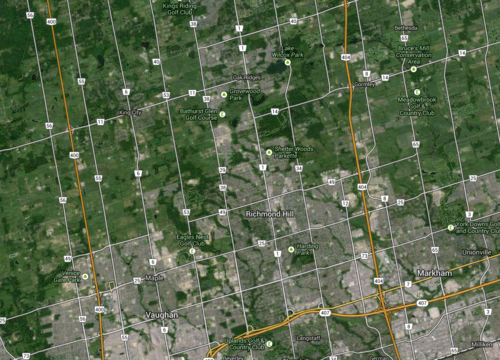
    These streets are actually concession roads. And they were used to subdivide undeveloped land in Upper and Lower Canada into a grid that could then be further subdivided into farming lots. Each square of the grid is 2 km x 2 km, or 1,000 acres.

    Look at a map of the Greater Toronto Area and you’ll see it:

    image

    But what I find most intriguing about this grid system is that it was designed around farming—not our current use case. The intent was to further subdivide each 1,000 acre lot into smaller 100 acre farming lots. And these concession roads were for access—they weren’t city blocks.

    By comparison, there’s another city that’s famously run off a regular street grid. You may have heard of it. It’s called New York. And its street grid was established in the Commissioner’s Plan of 1811. Some even go so far as to say that it’s “the single most important document in New York’s development.” 

    But New York’s grid is much different than the one I’m talking about. Because of its smaller scale (20 blocks a mile going north-south), New York’s was decidedly urban. It was meant for city building.

    Now, in the case of Toronto, concession roads obviously never stopped us from developing a thriving city. We filled in each square to make them as urban as we needed them to be. But as planning ideals changed, so did the infilling of those squares. Our grid was flexible enough to accommodate everything from farm land to suburban subdivisions.

    But I can’t help but wonder how the Greater Toronto Area would have turned out had we, quite simply, chosen a different size of square. What if instead of 2 km x 2 km, we had made them 1 km x 1 km? Or what if we made them even smaller? What would the Toronto region look like today?

    Sometimes it may seem like a simple decision, but in reality the implications are huge.

  • Mall or Main Street?

    It’s December. You’re in Toronto. The high for today is 5 degrees celsius. But the overnight low is expected to reach -11. Would you rather shop inside a warm mall or outside along a hip urban Main Street?

    This is a question that has come up a number of times in retail real estate meetings here in Toronto and the general consensus is often that people in our climate don’t want open air malls and Main Streets. They prefer enclosed malls.

    However, this is not to say that we don’t have open air malls and that we don’t have a thriving downtown, because we do.

    What I am saying though is that when the pension funds sit around contemplating what retail investments to make, they’re still largely thinking enclosed shopping centers. That’s why it seems like every major mall in Toronto is going through an expansion.

    But still, I wonder what the actual consumer preference is. Is it really our climate? Or have we just become accustomed to driving to the mall? Here’s a similar blog post talking about the Finnish obsession with shopping centers and malls.

    Generally speaking, I don’t love malls. There’s no urban authenticity. I find it much more enjoyable shopping at one-off and independent stores. But is this just a snobby architect, planning thing? I’d love to continue the conversation on twitter.

  • Please don’t walk on the grass

    The blog of Gehl Architects, called Cities for People, wrote a post this morning called, “Reflecting on Urban Play in Denmark.

    It’s a good follow-up to the post I did a week ago called, “Skateboarding and the city”, because in many ways, the example I gave (LOVE Park) is an extreme case of what Cities for People is talking about:

    “This sign, and other familiar signs such as “Please Don’t Walk on the Grass” characterize a common understanding of the urban landscape and its features as something to visually admire from a distance rather than interact with. While play and physical interaction with our surroundings is an intuitive social behavior, playful uses of the urban landscape and its features are often regarded as an illegitimate use of city space.”

    It’s the equivalent of buying a sofa, covering it with plastic, and not letting anyone sit on the damn thing. What’s the point?

    Fortunately, Copenhagen seems to be bucking that trend. Here are a few examples.

  • Urbanization in the developing world

    A few days ago I asked a reader of this blog if there was anything, in particular, that she’d like to see more of on here. She responded by saying that she’d love to learn more about how other cities—outside of Toronto—are managing urbanization, as well as how we shape cities and cities shape us.

    It’s an interesting and important question because, frankly, the challenges are greater outside of Toronto. One of the stats that often gets cited here in the media is how the Greater Toronto Area gets approximately 100,000 new immigrants every year. This doesn’t include domestic migration though, so I would assume that our total number is even greater.

    But if we stick with 100,000 for now, it means the GTA receives about 11.4 new immigrants every hour (100,000 people / 8,765 hours in a year). Lagos, Nigeria, on the other hand, receives between 50-60 new people every hour. In fact, it’s predicted to be 7th fastest growing city in the world between now and 2020. 

    If you take a look at the complete list of the world’s fastest growing cities (all estimates, of course), you’ll likely notice that the vast majority of the cities are in the developing world. And that’s really the challenge. The world is rapidly urbanizing and becoming the most urban it’s ever been, but the changes are the greatest outside of developed nations. This poses entirely unique challenges.

    Of the kinds of cities I’m talking about, I’m most familiar with Dhaka, Bangladesh. In my last year at Penn, I was part of a studio led by KieranTimberlake Architects that focused on water and housing issues in that city. It was a partnership with the University of Dhaka. We spent roughly 2 weeks there and it was an eye opening experience.

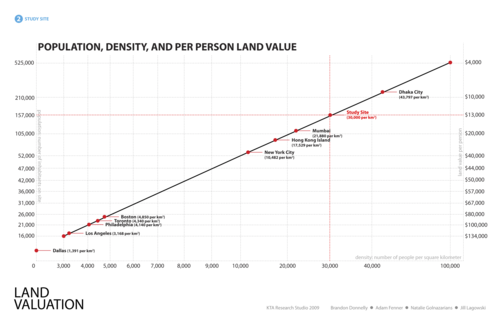
    Here’s a telling slide from our final presentation:

    image

    What we were trying to do with this chart was compare population and per person land value for our development site according to various city types. In other words, we were essentially asking: If we were to build out our proposed site in the same way, as say, Dallas, Los Angeles, Hong Kong, or what is typical for Dhaka, how many people could we fit and what would be the resulting per person land value?

    I don’t remember where we got the land value figures from, but we were trying to be cognizant of the fact that every city requires a unique solution. Using the same per person land values in Dhaka as in Dallas would be unimaginable because Dhaka has over 40,000 people per square kilometre (top right on the diagonal line above) and Dallas has under 1,400 per square kilometre (bottom left on the diagonal line above).

    The challenges of urbanization in the developing world are profound, particularly in places like Dhaka where most of the city is subject to severe annual floods. By some estimates, 18% of the city’s land area gets flooded every year—talk about adding another layer of city building complexity.

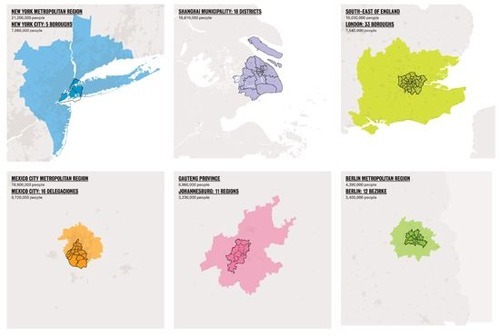
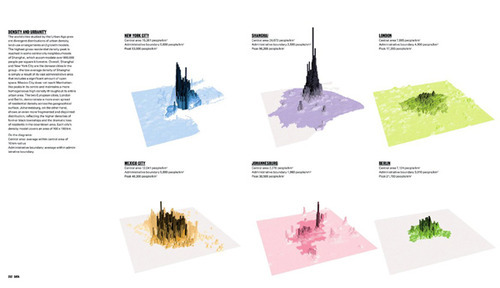
    We didn’t solve all of the problems in that studio and we’re not going to do it here, but I do think it’s important to fully understand the problem. One of my favorite books on cities is called “The Endless City.” It examines New York, Shanghai, London, Mexico City, Johannesburg and Berlin, and has a ton of great data and diagrams.

    Here are a two that outline densities and land use patterns for the above 6 cities (same order starting on the top left):

    image

    image

    If you’re interested in cities, it’s definitely worth having it on your coffee table. And fitting to @PhatNancy’s tweet, ”The Endless City doesn’t just show how cities are changing but also how they are changing us.

  • The Penn Annual

    I spent this morning booking the last leg of my flights for my annual ski and snowboarding trip this February. It’s a tradition that a few of us started during grad school at Penn. We call it the “Penn Annual” and we’re now into our fifth year. This year we’re going to Jackson Hole, which has been on the top of my list of places to snowboard for a number of years now.

    We started the Annual because we obviously love to ski and snowboard, but we also did it as a way to reconnect at least once a year. It’s a forced reunion. We pick a spot and all convene. The core group is about 4-5 people. But depending on where we go, it often expands as local friends and family join in. 

    Interestingly enough, we’re apparently a defined target market known as the “brocation” segment. Or at least this is what a marketing guy told us during the Third Annual in Lake Tahoe. So far we’ve been to Tremblant, Stowe, Lake Tahoe and Whistler. We usually alternate between Canada and the US. Next year we’re already thinking it’ll be Banff.

    One of the things we’ve talked about doing since the beginning is turning the The Annual into a larger Penn alumni reunion and networking event. In fact, we’ve parked pennannual.com. If we did this, we could bring down the per person costs, as well as create a much larger pull for participants. I love the idea of staying connected and meeting new Quakers (as well as others).

    Of course this is one of those ideas that usually loses air once the trip is over. But this year I thought I’d put it out there on my blog, and also send the idea over to Penn Alumni. So if you’d like to join us in Jackson Hole, drop me a line.

  • Merry Christmas

    Merry Christmas everyone! I love it when Toronto gets a white Christmas.

    If you were hit by #icestorm2013, then you may still be without power. If that is the case, I hope you’ve found someplace warm to celebrate with friends and loved ones.

  • BlackBerry started our forest

    A friend of mine posted this article on my Facebook wall yesterday: “A Snowier Silicon Valley in BlackBerry’s Backyard.

    It essentially talks about the fact that despite the rapid decline of BlackBerry (it just reported $4.4 billion in losses), the Kitchener-Waterloo region is thriving. Many companies—both local and international, such as Google and Motorola, Square, Desire2Learn, Kik and others—have all hung their shingle in the area. 

    Part of this certainly has to do with the University of Waterloo, but much of it also has to do with the legacy of BlackBerry. In fact, you could argue that BlackBerry (formerly Research in Motion) is what started at all.

    In reading the New York Times article I was reminded of a post that Fred Wilson wrote last year called, “The Darwinian Evolution of Startup Hubs.” It’s a great post. In it he talks about how he looks for the company that gave birth to the hub. In Silicon Valley he argues that it was Fairchild Semiconductor and in New York it was Doubleclick.

    Once started, he likens the hub to a growing forest. The big trees (mature companies) start dropping seeds and new trees then start to grow (more startup companies). This is important, because it kick-starts a non-linear cycle of entrepreneurial growth.

    Here’s how he maps out Silicon Valley:

    “In my mental model of Silicon Valley, the first “tree” was Fairchild Semiconductor (founded in 1957) which begat Intel (founded 1968) which begat Apple (1976) and Oracle (1977), which begat Sun (1982), Silicon Graphics (1981), and Cisco (1984) which begat Siebel (1993) and Netscape (1994), which begat Yahoo! (1995) and eBay (1995), which begat Google (1998) and PayPal (1998), which begat YouTube (2005), Facebook (2004), and LinkedIn (2003) which begat Twitter (2006) and Zynga (2007), which begat Square (2010), Dropbox (2008), and many more.”

    Using this logic, Fred Wilson argues that Silicon Valley is about 10 cycles in and New York is at about 2. So what about Kitchener-Waterloo? Well if you buy into the argument that BlackBerry is what started it all, we’re really only into our first cycle. BlackBerry created a lot of wealth and talent, and now it’s being deployed into local startups. Our forest has begun.

    Part of me worries, though, if Kitchener-Waterloo is the right place for a startup hub over the long term. Sure it has the University of Waterloo, but does young talent want to be there? At about 320,000 people, it’s no San Francisco, New York or Toronto. And we’re already seeing a significant pull towards urban centers.

    But let’s look at it from the perspective of Southern Ontario as a whole. We’re at a critical moment in our evolution. The mother tree has caught a disease and it’s starting to take its toll. It may be able to fight it off, but right now it’s not looking promising. Thankfully, there are many young trees sprouting up to replace it. But we’re going to need to take special care of them, because they’re probably our best shot at creating our own thriving forest.

  • Why real estate is an imperfect market

    I’ve said many times before that the real estate market is an imperfect one. Participants lack access to a lot of valuable information and there’s a significant amount of friction between buyers and sellers.

    A perfect example of this can be found in this recent Toronto Star article, which is suggesting (at least in the headline) that only about 23% of Toronto’s condos are owned and rented out by investors. The article is reporting on the Canada Mortgage and Housing Corporation’s annual publication called the Canadian Housing Observer.

    Of course, to come up with this number, CMHC is only reporting on data held by the MLS. It does not include units that may have been rented out via Craigslist, Kijiji, social media, a billboard in the lobby, or some other means. And I would argue that the rental side of the marketplace has a much stronger tendency to go outside of MLS as compared to sales.

    So what what this means is that we have absolutely no idea what the actual percentage of investor owned units in the city really is. Here’s how CMHC put it:

    Mathieu Labarge, CMHC’s deputy chief economist, acknowledged that “to complete the picture there’s a need for data,” and it simply doesn’t exist.

    Nobody seems to know exactly where buyers, or their money, is coming from, why they are buying and how they intend to use the condo.

    In reality, the investor percentage is going to be higher:

    “We think the number is closer to 50 per cent,” says veteran Toronto development consultant Barry Lyon. “The data they (CMHC) are using has some shortcomings. It’s only part of the story.”

    Now, I don’t have the answer, but I think it’s pretty safe to say that consumers and the market as a whole would be better off if it had all the information.

  • Am I supposed to like this city?

    Marketer Seth Godin just wrote a typically short blog post called, “Am I supposed to like this?

    In it he talks about the fact that we are, for example, more likely to enjoy the food at a fancy restaurant. And we’re also more likely to enjoy a bottle of wine if it’s expensive or if we believe it comes from some desirable wine region and it’s supposed to be good (you can even just switch the bottle).

    He then sums up this idea in one line that I really like: “Judgments happen long before we think they do.”

    Now, I’ve thought about this same idea with respect to cities. Take New York, for example. New York is famous. If I had to pick a capital for the world, it would probably be New York.

    You watch it in movies and shows (even if it’s actually filmed in Toronto, Chicago or some other stand in). We read about it. We hear about it. We generally form judgments without the actual experiences. That builds brand equity. We’re supposed to like New York. Sex and the City told us so. And that makes it all that much better when we eventually get there.

    Of course, it’s a bit of a catch-22. You have to be an awesome city for people to want to make movies and songs about you. But in this era of global connectedness, I think everyone, from citizens to economic development agencies, can fake it until that city makes it by investing in “supposed to.” Am I supposed to like this city?